S1: Are you testing your adv thyroid cancer patients for biomarkers?
S2: RET fusions or mutations may be driving adv thyroid cancer
S3: Consider testing all of your adv thyroid cancer patients for biomarkers
S4: Are you available to talk about RET’s role in adv thyroid cancer?
|
|
Pre-header: Your patients may benefit from a targeted treatment option
|
[From: <Rep Name> (REPNAME@blueprintmedicines.com)]
[Sent: <MM/DD/YYYY HH:MM AM/PM>]
[To: <Last Name, First Name>]
|

|
|
[pick list]
[Dear]
[Hello]
[pick list]
[Dr. Last Name],
[First Name],
[First Name Last Name],
|
|
[Customize the text here with your own message to the healthcare provider in alignment with FDM. You may only send a 200-character message in alignment with FDM.]
|
|
Take a closer look at what might be driving advanced thyroid cancer and available treatment options.
|
|
|
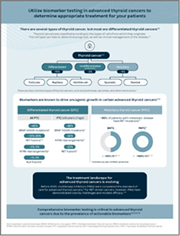
Biomarkers, including RET, are known to drive oncogenic growth in certain advanced thyroid cancers.1-10
|
|
In Papillary Thyroid Cancer
|
~10%-20%
RET fusions2-4
|
~2%-3%
NTRK rearrangements5
|
~1%-3%
ALK fusions6
|
~45%
BRAF V600E mutations1
|
|
|
In Medullary Thyroid Cancer
|
~90% of patients with metastatic
disease have RET mutations7
|
|
SMTC
|
FMTC*
|

|

|
|
~50% RET8-10
|
~100% RET8-10
|
|
|
|
|
*Germline as part of MEN2 syndrome.
|
|
|
|
RET can also be found in follicular thyroid cancer, Hürthle cell thyroid cancer, and advanced anaplastic and poorly differentiated thyroid cancers.2,11-13
|
Learn more about RET in advanced TC,
including guidelines on testing

|
|
ALK=anaplastic lymphoma kinase; BRAF=B-Raf proto-oncogene; FMTC=familial medullary thyroid cancer; MEN2=multiple endocrine neoplasia type 2; NTRK=neurotrophic tyrosine receptor kinase; PTC=papillary thyroid cancer; RET=rearranged during transfection; SMTC=sporadic medullary thyroid cancer; TC=thyroid cancer.
|
|
Targeted therapies are available to specifically target RET in certain advanced thyroid cancers.1,14
|
|
Therefore, it’s important to test for biomarkers in advanced thyroid cancers to help determine an appropriate treatment for your patients.
|
Learn more about an
approved RET-targeted therapy
|
|
|
| I’m including some additional resources about biomarker testing and RET in advanced thyroid cancer: |
[Fragment/attachment pick list]
|
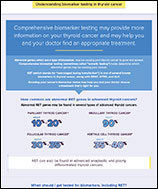
[Thyroid Cancer Biomarker Testing Flashcard]
|
|
|
|
[Biomarker Testing in Advanced Thyroid Cancer Fact Sheet for Patients]
|
|
|
|
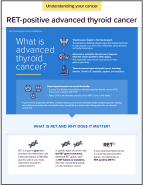
[RET+ Advanced Thyroid Cancer Fact Sheet for Patients]
|
|
|
|
|
|
|
Please let me know if you’d like to set up a
[pick list]
[falsecalltruevideo chattruemeeting],
or if you have any questions.
|
[pick list]
[Sincerely],
[Best],
|
|
[Rep photo]
|
[pick list]
[Rep name]
[Rep title]
Blueprint Medicines
[Rep phone number]
[Rep email address]
|
|
|
|
References:
1. Referenced with permission from the NCCN Clinical Practice Guidelines in Oncology (NCCN Guidelines®) for Thyroid Carcinoma V.3.2022. © National Comprehensive Cancer Network, Inc. 2022. All rights reserved. Accessed November 1, 2022. To view the most recent and complete version of the guideline, go online to NCCN.org.
2. Drilon A, Hu ZI, Lai GGY, Tan DSW. Targeting RET-driven cancers: lessons from evolving preclinical and clinical landscapes. Nat Rev Clin Oncol. 2018;15(3):151-167.
3. Kato S, Subbiah V, Marchlik E, Elkin SK, Carter JL, Kurzrock R. RET aberrations in diverse cancers: next-generation sequencing of 4,871 patients. Clin Cancer Res. 2017;23(8):1988-1997.
4. Santoro M, Carlomagno F, Hay ID, et al. Ret oncogene activation in human thyroid neoplasms is restricted to the papillary cancer subtype. J Clin Invest. 1992;89(5):1517-1522.
5. Lee YC, Chen JY, Huang CJ, Chen HS, Yang AH, Hang JF. Detection of NTRK1/3 rearrangements in papillary thyroid carcinoma using immunohistochemistry, fluorescent in situ hybridization, and next-generation sequencing. Endocr Pathol. 2020;31(4):348-358.
6. Panebianco F, Nikitski AV, Nikiforova MN, et al. Characterization of thyroid cancer driven by known and novel ALK fusions. Endocr Relat Cancer. 2019;26(11):803-814.
7. Romei C, Ciampi R, Casella F, et al. RET mutation heterogeneity in primary advanced medullary thyroid cancers and their metastases. Oncotarget. 2018;9(11):9875-9884.
8. Priya SR, Dravid CS, Digumarti R, Dandekar M. Targeted therapy for medullary thyroid cancer: a review. Front Oncol. 2017;7:238.
9. Subbiah V, Gainor JF, Rahal R. Precision targeted therapy with BLU-667 for RET-driven cancers. Cancer Discov. 2018;8(7):836-849.
10. Krampitz GW, Norton JA. RET gene mutations (genotype and phenotype) of multiple endocrine neoplasia type 2 and familial medullary thyroid carcinoma. Cancer. 2014;120:1920-1931.
11. Borowczyk M, Szczepanek-Parulska E, Dębicki S, et al. Differences in mutational profile between follicular thyroid carcinoma and follicular thyroid adenoma identified using next generation sequencing. Int J Mol Sci. 2019;20(13):2126.
12. de Vries MM, Celestino R, Castro P, et al. RET/PTC rearrangement is prevalent in follicular Hürthle cell carcinomas. Histopathology. 2012;61(5):833-843.
13. Nikiforov YE. Genetic alterations involved in the transition from well-differentiated to poorly differentiated and anaplastic thyroid carcinomas. Endocr Pathol. 2004;15(4):319-327.
14. Subbiah V, Shen T, Terzyan SS, et al. Ann Oncol. 2021;32(2):261-268.
|
|
|
|
|