[pick list]
[Dear]
[Hello]
[pick list]
[First Name],
[First Name Last Name],
[Dr. Last Name],
|
[pick list]
false[I appreciate that your time is valuable. When you're available, I'd like to speak with you about the importance of biomarkers, like RET, and comprehensive biomarker testing in NSCLC.]
true[Thank you for taking time out of your busy day to speak with me.]
true[I wanted to check in with you and see how things are going.]
|
|
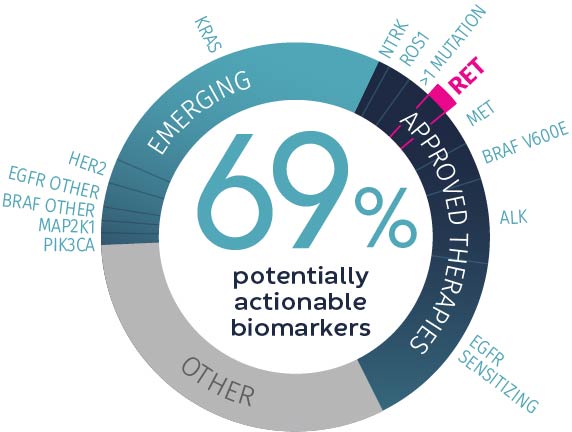
There are more targeted therapies available today than ever before for the treatment of metastatic non–small cell lung cancer
(NSCLC). In fact, there are now 7 actionable biomarkers with approved targeted therapies. Up to 69% of patients with NSCLC
could have a potentially actionable biomarker.1,2
|
|
|
It's important to identify biomarkers with broad molecular testing like next generation sequencing and, if clinically appropriate, wait for test results to confirm treatment.3,4
|
|
To identify oncogenic drivers, such as RET, in eligible patients with metastatic NSCLC, and to determine if these patients are eligible for targeted therapy, the National Comprehensive Cancer Network® (NCCN®) NSCLC Panel recommends molecular testing for actionable biomarkers, including RET, and strongly advises broad molecular profiling.5*
|
|
I’ve included some information I hope you’ll find useful.
|
|
|
[email fragments]
|
|
| RET+ NSCLC Disease Education Flashcard |
|
Information on RET+ NSCLC and the importance of comprehensive biomarker testing in NSCLC.
|
|
|
|
|
|
| Expert Insights Video: Dr. Burns' Overview of Biomarker Testing in NSCLC |
|
See what Dr. Timothy Burns, medical oncologist at UPMC Hillman Cancer Center, has to say about the importance of biomarker testing.
|
|
|
|
|
|
| Visit the HopeinRET.com Website |
|
Read more about RET+ NSCLC and biomarker testing at the official "Hope Is in Bloom in RET+ NSCLC" website.
|
|
|
|
|
|
I would be happy to set up a quick
[pick list]
[
falsecall
truevideo chat
truemeeting
]
to discuss any questions you have. Please feel free to contact me at
[pick list]
[
falserep email
truerep phone number
].
|
[pick list]
false [Sincerely,]
true [Best,]
|
|
[Rep photo]
|
[Rep name]
[Rep title]
|
|