|
|
|
|
|
What is ORENCIA?
|
ORENCIA (abatacept) is a prescription biologic medicine used to reduce signs and symptoms of moderate to severe Rheumatoid Arthritis (RA) in adults 18 years and older. Taking ORENCIA may prevent further damage to your bones and joints, and may help your ability to perform daily activities. ORENCIA may help those who are not getting the results they need with other medicines for RA.
In adults, ORENCIA may be used alone or with other RA treatments, but should not be used with TNF-blockers (also called Tumor Necrosis Factor antagonists). TNF-blockers are a type of RA medication, and include such treatments as Enbrel® (etanercept), Humira® (adalimumab), and Remicade® (infliximab).
|
 |
ORENCIA is for adults 18 years and older with moderate to severe Rheumatoid Arthritis (RA).
|
 |
ORENCIA should not be used with TNF-blockers.
|
|
|
ORENCIA is available in two forms:
|
 |
|
|
|
OR
|
|
|
|
|
|
What should I discuss with my rheumatologist before starting ORENCIA?
|
 |
Tell your rheumatologist about all of your medical conditions, including if:
|
|
|
•
|
You have any kind of infection, as you may have a higher chance of getting serious side effects from an infection while taking ORENCIA. Infections include:
|
|
|
•
|
Small infections (such as an open cut or sore) to whole body infections (such as the flu).
|
|
•
|
Any infection that will not go away or a history of infections that keep coming back.
|
|
•
|
Viral hepatitis, a viral infection that affects the liver. Tell your rheumatologist if you have or have ever had viral hepatitis. Before starting ORENCIA, your rheumatologist may examine you for hepatitis.
|
|
•
|
Tuberculosis (TB), a type of lung infection. Tell your rheumatologist if you have ever had TB or a positive skin test for TB, or have recently been in close contact with someone who has ever had TB. Before starting ORENCIA, your rheumatologist may check you for TB or do a skin test. Call your rheumatologist if you notice any symptoms of TB, including: a cough that does not go away, weight loss, fever, or night sweats.
|
|
|
•
|
You have allergies to the ingredients of ORENCIA. For a list of ingredients, see What are the ingredients in ORENCIA? in the Patient Information section of the Full Prescribing Information.
|
|
•
|
You have Chronic Obstructive Pulmonary Disease (COPD), a type of lung disease.
|
|
•
|
You have diabetes. Your healthcare provider may tell you to use a different way to monitor your blood sugar levels on the day that you receive ORENCIA IV infusion. ORENCIA IV contains maltose, which can alter the blood sugar readings with certain types of blood glucose monitors.
|
|
|
|
Talk to your rheumatologist about all of your medical treatments,
including if:
|
|
|
•
|
You are scheduled to have surgery.
|
|
•
|
You recently received or are scheduled to receive vaccinations.
|
|
•
|
You are taking:
|
|
|
•
|
Other medications for RA.
|
|
•
|
Prescription medications or over-the-counter medications.
|
|
•
|
Vitamins or herbal supplements.
|
|

|
Let your rheumatologist know if you are a woman who is: |
|
|
•
|
Pregnant or considering pregnancy. It is not known if ORENCIA can harm an unborn baby. If ORENCIA is taken during pregnancy, talk to your healthcare provider before your baby receives any vaccines.
|
|
•
|
Breastfeeding or planning to breastfeed. It is not known if ORENCIA passes into breast milk. Talk to your healthcare provider about the best way to feed your baby if you use ORENCIA.
|
|
|
What should I avoid while I am on ORENCIA?
|
ORENCIA and other medicines may affect each other, which could cause serious side effects.
You should avoid taking ORENCIA with other biologics for your RA
that may affect your immune system. Doing so may increase your chances of getting a serious infection.
|
|
Tell your rheumatologist if you are taking other biologic
medicines to treat RA, such as:
|
|
|
Enbrel® (etanercept)
|
|
Humira® (adalimumab)
|
|
Remicade® (infliximab)
|
|
Kineret® (anakinra)
|
|
|
Rituxan® (rituximab)
|
|
Simponi® (golimumab)
|
|
Cimzia® (certolizumab pegol)
|
|
Actemra® (tocilizumab)
|
|
|
|
|
Talk to your rheumatologist and your other healthcare providers before you begin to take anything new or if you have any changes to
your medicines during your treatment with ORENCIA. It is a good idea to keep an up-to-date list of all of your medicines, vitamins,
and herbal supplements on hand to show your doctors and pharmacists.
|
|
|
What are the possible side effects of ORENCIA?
|
|
This is a list of some of the possible side effects of ORENCIA for your reference.
|
|
|
Talk to your rheumatologist about any side effect that may be bothering you. Your rheumatologist can work with you to
manage side effects throughout your treatment.
|
|
Serious side effects
Serious side effects are those that may require medical treatment or hospitalization, cause permanent damage, or be life-threatening or
sometimes even fatal. Talk to your healthcare provider about any concerns you may have.
|
|
•
|
Infections. ORENCIA can make you more likely to get infections or make the infections that you have worse. In some cases, these
infections have been fatal. Symptoms of an infection include:
|
|
|
•
|
Fever
|
|
•
|
Cough
|
|
•
|
Warm, red, or painful skin
|
|
|
•
|
Feeling very tired |
|
•
|
Flu-like symptons
|
|
|

|
Call your healthcare provider right away if you feel sick or have any of the symptoms of an infection.
|
|
|
•
|
Allergic reactions. Allergic reactions can happen with ORENCIA. Symptoms of an allergic reaction may include:
|
|
|
•
|
Hives
|
|
•
|
Swollen face, eyelids, lips, or tongue
|
|
•
|
Trouble breathing
|
|
|
Seek urgent medical attention if you have any of the symptoms of an allergic reaction.
|
|
|
•
|
If you have the hepatitis B virus, talk to your healthcare provider as
hepatitis B can become an active infection while you use ORENCIA. Your rheumatologist may do blood tests before treatment with ORENCIA to check if you have hepatitis B.
|
|
•
|
If you are receiving or are scheduled to receive vaccinations, it is important to know that:
|
|
|
•
|
You should not receive live vaccines while taking ORENCIA and for 3 months after ending treatment, as it may cause serious side effects.
|
|
•
|
ORENCIA may also cause some other vaccinations to be less
effective.
|
|
|
Talk to your rheumatologist about your vaccination plans.
|
|
|
•
|
If you have Chronic Obstructive Pulmonary Disorder (COPD), you may experience
breathing problems more often while taking ORENCIA. Call your healthcare provider if you experience any of the following:
|
|
|
•
|
Worsened COPD
|
|
•
|
Cough
|
|
•
|
Trouble breathing
|
|
|
•
|
Certain kinds of cancer (malignancies) have been reported in people using ORENCIA. It is not known if ORENCIA increases your chances of developing certain kinds of cancer.
|
|
Most common side effects
Clinical studies looked at 1,955 patients who took ORENCIA. The most commonly reported side effects occurred in 10% or more of patients.
|
|
|
Common side effect
|
How many patients
experienced it?
|
|
Headache
|
18% (356 of 1,955 patients)
|
|
Upper respiratory tract infection
|
13% (248 of 1,955 patients)
|
|
Sore throat
|
12% (225 of 1,955 patients)
|
|
Nausea
|
12% (224 of 1,955 patients)
|
|
These are not all of the possible side effects of ORENCIA. If you have any questions or want more information about side effects,
ask your rheumatologist or healthcare provider.
If you experience any side effects and would like to report them to the FDA, you can call 1-800-FDA-1088.
|
|
How will I receive ORENCIA?
|
ORENCIA is available in two forms, as intravenous (IV) infusions and as subcutaneous (SC) injections. Work with your rheumatologist to determine the right treatment plan for you.
|
 |
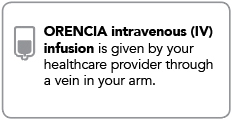
ORENCIA IV infusion is given by a healthcare provider through a vein in your arm.
|
|

|
You will receive your first three infusions 2 weeks apart from each other (weeks 0, 2, and 4). After that, you will receive an infusion every 4 weeks.
|

|
Each infusion takes about 30 minutes, though actual time in the clinic will be longer.
|
|
 |
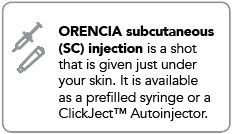
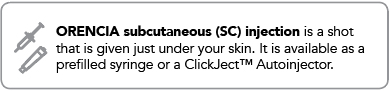
ORENCIA SC injection is a shot that is given just under your skin. It is available as a prefilled syringe or
ClickJectTM Autoinjector. If your rheumatologist decides that your injections can be given at home,
you or your caregiver will receive training on how to prepare and inject ORENCIA. Do not try to inject ORENCIA until you have been shown the right way
by your rheumatologist or healthcare provider.
|
|
|
|
You will use ORENCIA SC injection once weekly.
|

|
For more information about preparing and giving ORENCIA SC
injections at home, see Instructions for Use in the Patient Information section of the
Full Prescribing Information.
|
|
|
Please read the Patient Information in the Full Prescribing Information by clicking here.
|
Sincerely,
Your ORENCIA Care Counselor
|
| We're just a phone call or click away |
|
Sign up now or call 1-800-ORENCIA (1-800-673-6242).
|