|
| S1: | Learn more about an enzyme replacement therapy for an ultra-rare disorder | | S2: | Examine clinical data for a treatment indicated for patients with an ultra-rare lysosomal storage disorder | | S3: | For your patients with this ultra-rare lysosomal disorder, treatment is now available |
|
| PH: | Could patients in your practice be eligible for this therapy? |
|
From: [{{userName}} <{{RepEmailAddress}}>]
Reply To: [{{userName}} <{{userEmailAddress}}>]
Sent: [<MM/DD/YYYY HH:MM AM/PM>]
To: [Last Name, First Name <email address>]
|
|

|

|
{{customText[falseHitrueHellotrueDeartrueGreetingstrueGood morningtrueGood afternoontrueGood evening]}}
{{customText[false##accTitle## ##accFname## ##accLname##true##accTitle## ##accLname##true##accFname##]}},
|
|
{{customText[falseThank you for taking the time to discuss Lamzede® (velmanase alfa-tycv) with me.trueThank you for requesting more info on Lamzede® (velmanase alfa-tycv).trueI look forward to our discussion about Lamzede® (velmanase alfa-tycv).trueI’m sorry we weren’t able to connect about Lamzede® (velmanase alfa-tycv).trueI wanted to share this information about Lamzede® (velmanase alfa-tycv) with you.]}}
|
|
Extensively studied in pediatric and adult patients with alpha-mannosidosis, this enzyme replacement therapy (ERT) is an exciting development in the world of rare disease that has long been awaited by patients and their caregivers.1
|
|
Lamzede—the first and only ERT approved for patients with alpha-mannosidosis1
|
|
Lamzede supplements the natural α-mannosidase enzyme. Until now, use of bone marrow transplantation (BMT) was the only option. However, BMT is often age-restricted, with a median of 3.6 years.1,2
|
|
Envision the impact Lamzede could make for your patients
|

|
Proven pharmacodynamics
A clinical trial studied the impact of Lamzede on the accumulation of mannose-rich oligosaccharides.1 See the data ▶
|

|
May help with walking performance
View the numerical trends shown by Lamzede in walking performance as measured by the 6MWT.1 Learn more ▶
|

|
May improve pulmonary function
Get the Lamzede 1-year clinical trial results in pulmonary function as measured by forced vital capacity (FVC%).1 Find out more ▶
|

|
Preserved endurance climbing stairs
See how Lamzede affected stair-climbing ability as measured by the 3MSCT.1 View clinical trial results ▶
|
|
|
3MSCT, 3-minute stair-climbing test; 6MWT, 6-minute walk test.
|
|
Please see Important Safety Information below including Boxed Warning and Full Prescribing Information for Lamzede.
|
|
[Lamzede Clinical Trial Program]
|
|
Review the extensive Lamzede clinical trial program3-11
|
|
For more background on Lamzede, explore the multiple Phase I, II, and III clinical trials, including a long-term trial of patients receiving Lamzede for up to 4 years.
|
|
Overview of Select Clinical Trials
|
Trial 1
rhLAMAN-05 (N=25): Multicenter, double-blind, randomized, placebo-controlled, parallel-group, Phase III trial of the efficacy and safety of repeated Lamzede treatment in patients with alpha-mannosidosis.9,10
|
Trial 2
rhLAMAN-08 (N=5): 24-month, multicenter, open-label, Phase II trial of the efficacy and safety of repeated Lamzede treatment in patients aged <6 years with alpha-mannosidosis.8
|
Trial 3
Integrated analysis of long-term outcome data that pooled cumulative databases from Phase I, II, and III trials (N=33) for patients aged ≥6 to 35 years.3
|
Additional study
rhLAMAN-10 (N=18): Single-center, open-label, Phase III clinical trial of the long-term efficacy of Lamzede treatment in patients with alpha-mannosidosis who previously participated in Lamzede trials of up to 4 years.11
|
|
|
rhLAMAN, recombinant human α-mannosidase.
|
|
[Lamzede Trial Data]
|
|
Proven to deliver results for both adults and children in a 1-year trial10
|
|
When it comes to efficacy, Lamzede has favorable results in several important disease categories.
|
|
Trial 1 (rhLAMAN-05) was a Phase III, international, multicenter, double-blind, randomized, placebo-controlled, parallel-group trial10
|
|
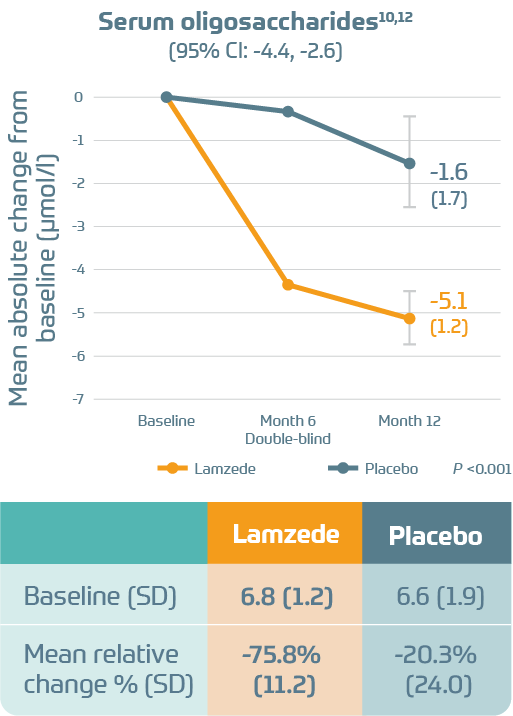
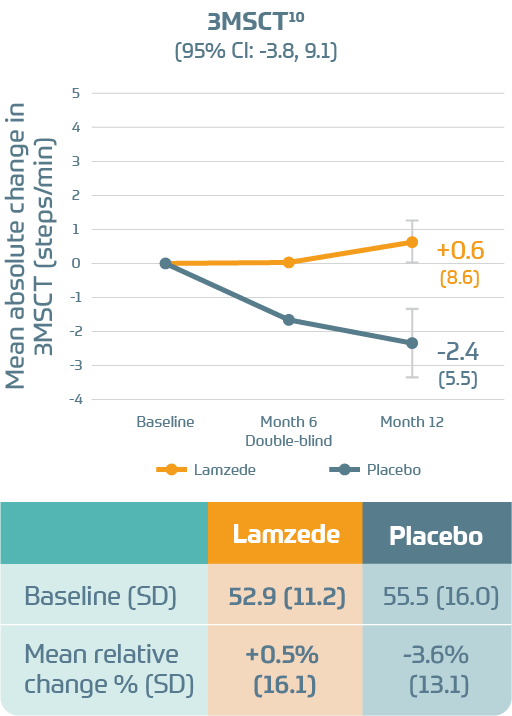
Co-primary endpoints10
|
| • |
Serum oligosaccharides change from baseline to week 52 |
| • |
3-minute stair climbing test (3MSCT) from baseline to week 52 |
|
|
Reduction in a key marker of impaired cellular function1
|
| • |
Improvements at 6 months that continued at 1 year |
|
|
|
|
Maintained endurance climbing stairs, as measured by the 3MSCT1,*
|
| • |
Patients who received placebo declined over time |
|
|
|
*Differences in 3MSCT were not statistically significant.
|
|
|
|
Reduction in a key marker of impaired cellular function1
|
| • |
Improvements at 6 months that continued at 1 year |
|
|
|
|
Maintained endurance climbing stairs, as measured by the 3MSCT1,*
|
| • |
Patients who received placebo declined over time |
|
|
|
|
*Differences in 3MSCT were not statistically significant.
|
|
|
Prioritized secondary endpoints1,10
|
|
Endurance walking, as measured by the 6-minute walk test (6MWT) (change from baseline to week 52)
|
| • |
Patients receiving Lamzede achieved a 4.4 (46.1%) change (95% CI: -30.7, 45.5) vs -4.6 (40.8%) for patients on placebo† |
|
|
Pulmonary function, as measured by forced vital capacity percentage (FVC%, measured by spirometry) of predicted normal value (change from baseline to week 52)
|
| • |
Patients receiving Lamzede achieved an 8.2 (9.9%) change (95% CI: -5.0, 16.1) vs 2.0 (12.6%) for patients on placebo‡ |
|
†Differences in 6MWT were not statistically significant.
‡Differences in FVC test were not statistically significant.
|

|
|
[Lamzede Longterm Data]
|
|
Lamzede showed sustained pharmacodynamic and functional improvement for up to 4 years3
|
|
For a focus on long-term data, we can take a look at the results from Trial 3.
|
|
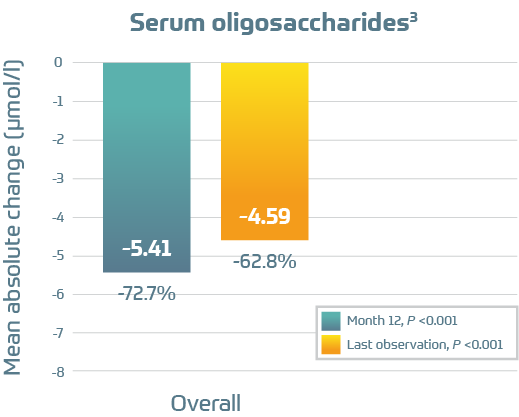
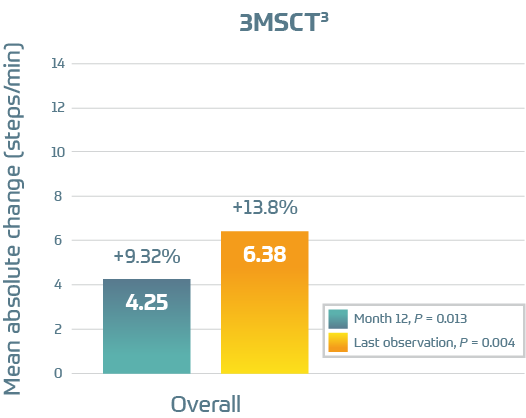
In this integrated analysis (N=33), investigators pooled the cumulative databases from Lamzede Phase I, II, and III trials in patients with alpha-mannosidosis.
|
|
Twenty male and 13 female patients aged 6 to 35 years old (14 adults, 19 pediatric) received Lamzede weekly for a mean exposure of 89 weeks in adult patients and 155 weeks in pediatric patients. Overall mean exposure was 29.3 (15.2 SD) months.3,*
|
|
Co-primary endpoints3
|
| • |
Serum oligosaccharides change from baseline to last observation |
| • |
3-minute stair climbing test (3MSCT) from baseline to last observation |
|
|
|
|
|
| * |
The integrated study design was necessary to assess long-term efficacy and safety in a progressively worsening disease despite the rarity of patient population. Although the placebo-control period was limited to 12 months, duration of follow-up and repeated assessments were designed to mitigate that limitation. Additionally, while the mean and median durations of exposure exceed 2 years, only a small proportion of patients in the developmental program have non-missing efficacy measurements after 18 months. Therefore, the ability of the integrated analysis to provide interpretable evidence of long-term efficacy is unclear.
|
|


|
|
[Lamzede Chiesi Total Care]
|
|
A one-stop resource for Chiesi patient support
|
|
A single call to your dedicated Chiesi Total CareSM Team is all it takes to begin the process of getting a patient started on Lamzede. The Care Team is comprised of pharmacists, patient service coordinators, reimbursement support, and nursing support.
|
|
Contact them for:
|
| • |
Infusion assistance*
|
•
|
Chiesi Total Care may help patients understand their medication and the infusion process, and coordinate a suitable infusion site if needed
|
|
•
|
If you determine home infusion is right for your patient, Chiesi Total Care may be able to assist eligible patients with delivery of medication and infusion supplies needed*
|
|
| • |
Routine testing
Healthcare providers should consider monitoring for the presence of serum oligosaccharide reduction and anti-drug antibodies in patients who demonstrate hypersensitivity reactions and should consider the risks and benefits of continued treatment in patients with serum oligosaccharide reduction and anti-Lamzede antibodies. There are no marketed tests for these antibodies against Lamzede. If monitoring is warranted, Chiesi Total Care may be able to help.
|
| • |
Insurance assistance
Support for access to Lamzede through commercial insurance, government insurance, or financial assistance.
|
| * |
Patients receiving treatment or residing in MA or RI are not eligible for infusion assistance. To receive home infusion support, patient must be referred to home infusion by their prescribing physician. Please refer to the full Terms and Conditions for additional eligibility requirements.
|
|

|
Chiesi Total Care is a comprehensive support program that provides exceptional service for you and your patients
|
|
|
|
|
Chiesi Total Care is a comprehensive support program that provides exceptional service for you and your patients
|
|
|
Chiesi Total Care provides nonfinancial assistance to patients with and without prescription drug coverage. Government-funded plans are not eligible for patient support services that provide financial support through the programs. If your patient is receiving treatment or residing in MA or RI, they are not eligible for infusion assistance. Please see the full Terms and Conditions for additional eligibility requirements.
|
|
Copay assistance
|
| With the Lamzede Copay Programs, eligibile patients may pay as little as $0 for their medication and/or infusions.† |
|
To be eligible for these programs:
|
| • |
Your patient must be enrolled in Chiesi Total Care. (Enrollment and Authorization Form will be mailed to your patient's home) |
| • |
Your patient must have commercial insurance and a valid prescription for a US FDA-approved indication for Lamzede |
| • |
Your patient must be a resident of the United States or one of its territories |
|
| Please refer to the full Terms and Conditions for additional eligibility requirements. |
| † |
Government-funded plans are not eligible for patient support services that provide financial support through the programs. Patients receiving treatment or residing in MA or RI are not eligible for home infusion services. To receive home infusion support, patients must be referred to home infusion by their prescribing physician.
|
|
|
|

|
|
|
| If you have any questions about Lamzede, please feel free to get in touch—my contact information is included below. |
| In the meantime, if you’d like to learn more, visit lamzede.com. |
|
{{customText[falseSincerelytrueBest regardstrueThank you]}},
|
|
{{userName}}
|
|
{{userEmailAddress}}
|
|
{{User.Phone}}
|
Indication
|
| Lamzede® (velmanase alfa-tycv) is indicated for the treatment of non-central nervous system manifestations of alpha-mannosidosis in adult and pediatric patients. |
| Important Safety Information |
|
WARNING: SEVERE HYPERSENSITIVITY REACTIONS
|
|
Hypersensitivity Reactions Including Anaphylaxis
|
|
Patients treated with Lamzede have experienced hypersensitivity reactions, including anaphylaxis. Appropriate medical support measures, including cardiopulmonary resuscitation equipment, should be readily available during Lamzede administration. If a severe hypersensitivity reaction (e.g., anaphylaxis) occurs, discontinue Lamzede immediately and initiate appropriate medical treatment. In patients with severe hypersensitivity reaction, a desensitization procedure to Lamzede may be considered.
|
|
|
|
Considerations Due to Hypersensitivity Reactions and/or Infusion-Associated Reactions (IARs)
|
|
Prior to Lamzede administration, consider pretreating with antihistamines, antipyretics, and/or corticosteroids. Inform patients and caregivers of the signs and symptoms of hypersensitivity reactions and IARs and instruct them to seek medical care immediately if such symptoms occur.
|
| • |
If a severe hypersensitivity reaction (including anaphylaxis) or severe IAR occurs, immediately discontinue Lamzede administration and initiate appropriate medical treatment.
|
| • |
In the event of a mild to moderate hypersensitivity reaction or a mild to moderate IAR, consider temporarily holding the infusion for 15 to 30 minutes, slowing the infusion rate to 25% to 50% of the recommended rate, and initiating appropriate medical treatment.
|
|
|
Hypersensitivity Reactions Including Anaphylaxis
|
|
Anaphylaxis and severe hypersensitivity signs and symptoms included cyanosis, hypotension, emesis, urticaria, erythema, facial swelling, pyrexia, and tremor.
|
|
Infusion-Associated Reactions (IARs)
|
|
The most frequent symptoms of IARs that occurred in >10% of the population were pyrexia, chills, erythema, vomiting, cough, urticaria, rash, and conjunctivitis.
|
|
Females of Reproductive Potential
|
|
Advise females of reproductive potential to use effective contraception during treatment and for 14 days after the last dose if Lamzede is discontinued. For females of reproductive potential, verify that the patient is not pregnant prior to initiating treatment with Lamzede.
|
|
Embryo-Fetal Toxicity
|
|
Based on findings from animal reproduction studies, Lamzede may cause embryo-fetal harm when administered to a pregnant female.
|
|
Common Adverse Reactions
|
|
The most common adverse reactions (incidence >20%) are hypersensitivity reactions including anaphylaxis, nasopharyngitis, pyrexia, headache, and arthralgia.
|
|
Please see Full Prescribing Information for Lamzede.
|
|
References: 1. Lamzede. Prescribing Information. Chiesi Farmaceutici S.p.A.; 2023. 2. Borgwardt L, Lund AM, Dali CI. Alpha-mannosidosis – a review of genetic, clinical findings and options for treatment. Pediatr Endocrinol Rev. 2014;12(suppl1):185-191. 3. Lund AM, Borgwardt L, Cattaneo F, et al. Comprehensive long-term efficacy and safety of recombinant human alpha-mannosidase (velmanase alfa) treatment in patients with alpha-mannosidosis. J Inherit Metab Dis. 2018;41(6):1225-1233. doi:/10.1007/s10545-018-0175-2. 4. The natural history of alpha-mannosidosis (HUE-MAN). ClinicalTrials.gov identifier: NCT00498420. Updated August 3, 2020. Accessed December 23, 2022. https://clinicaltrials.gov/ct2/show/NCT00498420. 5. Safety study of recombinant human alpha-mannosidase for the treatment of patients with alphamannosidosis. ClinicalTrials.gov identifier: NCT01268358. Updated August 3, 2020. Accessed December 23, 2022. https://clinicaltrials.gov/ct2/show/NCT01268358 6. Dose finding study of recombinant human alpha-mannosidase for the treatment of patients with alphamannosidosis. ClinicalTrials.gov identifier: NCT01285700. Updated September 26, 2012. Accessed December 23, 2022. https://clinicaltrials.gov/ct2/show/NCT01285700. 7. Long-term efficacy and safety of lamazym for the treatment of patients with alpha-mannosidosis. ClinicalTrials.gov identifier: NCT01681940. Updated March 29, 2017. Accessed December 23, 2022. https://clinicaltrials.gov/ct2/show/NCT01681940. 8. Trial on safety and efficacy of velmanase alfa treatment in pediatric patients with alpha-mannosidosis (rhLaman-08). ClinicalTrials.gov identifier: NCT02998879. Updated October 26, 2021. Accessed December 23, 2022. https://clinicaltrials.gov/ct2/show/NCT02998879. 9. A placebo-controlled phase 3 trial of repeated lamazym treatment of subjects with alpha-mannosidosis. ClinicalTrials.gov identifier: NCT01681953. Updated August 3, 2020. Accessed December 23, 2022. https://clinicaltrials.gov/ct2/show/NCT01681953. 10. Borgwardt L, Guffon N, Amraoui Y, et al. Efficacy and safety of Velmanase alfa in the treatment of patients with alpha-mannosidosis: results from the core and extension phase analysis of a phase III multicentre, doubleblind, randomised, placebo-controlled trial. J Inherit Metab Dis. 2018;41(6):1215-1223. doi:10.1007/s10545-018-0185-0. 11. Evaluation of long-term efficacy of treatment with lamazym (rhLAMAN-10). ClinicalTrials.gov identifier: NCT02478840. Updated November 20, 2020. Accessed December 23, 2022. https://clinicaltrials.gov/ct2/show/NCT02478840. 12. Data on file. Chiesi Farmaceutici S.p.A.; March 2016.
|
|

|
|
|
|
|