|
|
|
|
|
Learn about an FDA-approved treatment that decreases episodic attacks of certain types of muscle weakness and temporary paralysis
|
|
Trouble viewing this e-mail? Please click here to view in your browser. info@KEVEYIS.com
|
|
Dear Dr. [Name],
|
|
Primary Periodic Paralysis (PPP) is a rare condition that causes recurrent, progressive, and debilitating episodes of muscle weakness and temporary paralysis that impact patients’ lives.1-4 Although there are related variants, the most common forms of PPP are hyperkalemic and hypokalemic.5-9
|
|
KEVEYIS® is the first and only FDA-approved treatment indicated for hyperkalemic, hypokalemic, and related variants of Primary Periodic Paralysis.
|

|
|
Proven in 2 clinical studies, KEVEYIS can help patients gain greater control over PPP by decreasing the number, severity, and duration of attacks10,11
|
-
In Study 1, the primary efficacy measure was defined as the average number of self-reported attacks of muscle weakness per week. Patients treated with KEVEYIS experienced a decrease in the rate of weekly attacks versus patients treated with placebo who experienced an increase in the rate of attacks.10
-
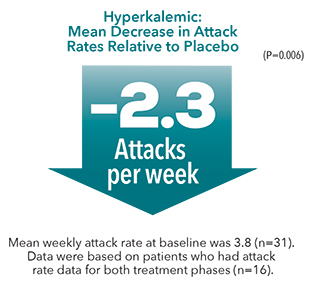
In Study 2, the primary efficacy measure for hypokalemic patients was defined as acute intolerable worsening necessitating withdrawal; for hyperkalemic patients, the primary efficacy measure was the average number of self-reported attacks of muscle weakness per week.10,12
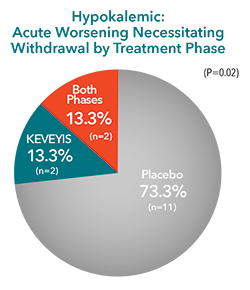 For hypokalemic patients who experienced acute worsening requiring withdrawal, the majority were treated with placebo. Hyperkalemic patients treated with KEVEYIS experienced a significantly decreased attack rate compared to when they were taking placebo.10,12
|
|
KEVEYIS has a demonstrated tolerability profile
|
- The most common adverse reactions (incidence at least ≥10% and rates greater than placebo) include paresthesias, cognitive disorder, dysgeusia, and confusional state (KEVEYIS n=36; placebo n=29).10
|
|
Getting started with KEVEYIS
|
- If you have a patient with PPP who may benefit from treatment with KEVEYIS, download the KEVEYIS Start Form and fax it to 844‑KEV‑1030 (844‑538‑1030).
|
|
|
|
Start the specialty pharmacy process for KEVEYIS →
|
|
|
|
Contact Strongbridge CareConnection—for 24/7 support and answers to your questions →
|
We are proud to offer a full range of services for patients with PPP who are taking KEVEYIS, as well as support for their healthcare providers. Please call 844‑KEVEYIS (538‑3947) for more information.
Sincerely,
The Strongbridge KEVEYIS Team
|
|
|
|
Indication
|
|
KEVEYIS is indicated for the treatment of primary hyperkalemic periodic paralysis, primary hypokalemic periodic paralysis, and related variants.
|
|
Important Safety Information
|
|
Contraindications
|
- Hypersensitivity to dichlorphenamide or other sulfonamides
- Concomitant use of KEVEYIS and high-dose aspirin
- Severe pulmonary disease, limiting compensation to metabolic acidosis caused by KEVEYIS
- Hepatic insufficiency: KEVEYIS may aggravate hepatic encephalopathy
|
|
Warnings and Precautions
|
-
Hypersensitivity/Anaphylaxis/Idiosyncratic Reactions
- Fatalities associated with the administration of sulfonamides have occurred due to adverse reactions including Stevens-Johnson syndrome, toxic epidermal necrolysis, fulminant hepatic necrosis, agranulocytosis, aplastic anemia and other blood dyscrasias.
- Pulmonary involvement can occur in isolation or as part of a systemic reaction.
- Discontinue KEVEYIS at the first appearance of skin rash or any sign of immune-mediated or idiosyncratic adverse reaction.
-
Concomitant Use of Aspirin
- Anorexia, tachypnea, lethargy, and coma have been reported with concomitant use of dichlorphenamide and high-dose aspirin.
- The concomitant use of KEVEYIS and high-dose aspirin is contraindicated.
- Use with caution in patients receiving low-dose aspirin.
-
Hypokalemia
- KEVEYIS increases potassium excretion and can cause hypokalemia.
- The risk of hypokalemia is greater when KEVEYIS is used in patients with conditions associated with hypokalemia (eg, adrenocortical insufficiency, hyperchloremic metabolic acidosis, or respiratory acidosis), and in patients receiving other drugs that may cause hypokalemia (eg, loop diuretics, thiazide diuretics, laxatives, antifungals, penicillin, and theophylline).
- Baseline and periodic measurements of serum potassium are recommended.
- If hypokalemia develops or persists, consider reducing the dose or discontinuing KEVEYIS.
-
Metabolic Acidosis
- KEVEYIS can cause hyperchloremic non–anion gap metabolic acidosis.
- Concomitant use of KEVEYIS with other drugs that cause metabolic acidosis may increase the severity of metabolic acidosis.
- Baseline and periodic measurements of serum bicarbonate are recommended.
- If metabolic acidosis develops or persists, consider reducing the dose or discontinuing KEVEYIS.
-
Falls
- KEVEYIS increases the risk of falls; risk is greater in the elderly and with higher doses.
- Consider dose reduction or discontinuation of KEVEYIS in patients who experience falls while treated with KEVEYIS.
|
|
Pregnancy and Lactation
|
|
Use during pregnancy only if the potential benefit justifies the potential risk to the fetus. It is not known in humans whether dichlorphenamide is excreted in human milk; exercise caution when administered to a nursing woman.
|
|
Adverse Reactions
|
|
The most common adverse reactions seen in clinical trials (incidence ≥ 10% and greater than placebo) include paresthesias, cognitive disorder, dysgeusia, and confusional state.
|
|
|
|
Please see Important Safety Information above, and click here for Full Prescribing Information →
|
|
References:
|

|
|
900 Northbrook Drive, Suite 200
Trevose, PA 19053
United States
www.KEVEYIS.com
www.strongbridgebio.com
© 2017 Strongbridge Biopharma plc
STRONGBRIDGE BIOPHARMA™ is a trademark
of Strongbridge Biopharma plc.
KEVEYIS® is a registered trademark
licensed exclusively in the US to Strongbridge Biopharma plc.
KEV-XXXX 09/2017
|
|
|