Insight from claims data can help shorten the diagnostic journey for patients with unexplained paralysis
 ‌ ‌ ‌ ‌ ‌ ‌ ‌ ‌  ‌ ‌ ‌ ‌ ‌ ‌ ‌ ‌  ‌ ‌ ‌ ‌ ‌ ‌ ‌ ‌
Trouble viewing this e-mail? Please click here to view in your browser.
USING PREDICTORS TO HELP
PATIENTS WITH PRIMARY
PERIODIC PARALYSIS (PPP)
RECEIVE A DIAGNOSIS1
Patients experiencing PPP symptoms are looking to you to validate their experience
PPP can be challenging to diagnose because symptoms are often nonspecific, with varying clinical presentations that can mimic other more common diseases.2,3 Most patients go many years and see multiple physicians before receiving an accurate diagnosis.2,3
How predictors may help to uncover PPP patients in your practice1
Strongbridge Biopharma analyzed historical claims data of real-world PPP patients to develop a predictive algorithmic model for helping clinicians diagnose the rare genetic condition based on predictive markers.*1 This model identified an important combination of predictors for PPP, then determined the correlation between their occurrence and PPP diagnosis.
Recognizing key predictors categorized by the specific codes listed below may help identify PPP patients and shorten the diagnostic journey.1 These predictors, in conjunction with clinical presentation, may be indicators of PPP. For example, PPP patients often do not complain of muscle weakness.
Key predictive codes
Predictors may help uncover undiagnosed PPP1
Codes predictive of PPP utilized prior to diagnosis*1:
CODE DESCRIPTION
276.8 Hypopotassemia
797000 Potassium
S44 Nerve injury
371000 Carbonic anhydrase inhibitors
780.7 Malaise and fatigue
728.8 Other disorders of muscle ligament and fascia
344.9 Paralysis, unspecified
780.2 Syncope and collapse
344.1 Paraplegia
372000 Loop diuretics
If you see a combination of these codes
in a single patient, suspect PPP.
Key predictive codes shown are from ICD-9 except for the six-digit codes for "Potassium," "Carbonic Anhydrase Inhibitors," and "Loop Diuretics," which are from the Medispan Therapeutic Classification system, and "Nerve injury," which is from ICD-10.1
* METHODOLOGY: A machine learning algorithm was developed that constructs multiple iterations of its predictive model based on subsets of real-world data extracted from the PPP patient journey. With each iteration, the algorithm attempts to correct the errors from prior iterations, thus continuously improving the overall accuracy of the model.
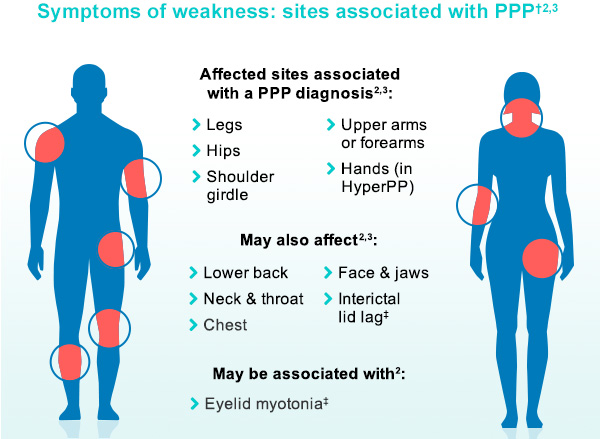
Sites with reported symptoms of Permanent Muscle Weakness in the subgroup of patients with permanent weakness (n=45).3
May be the only clinical sign present between attacks in hyperkalemic patients.2
Do you think you have patients with PPP? Order a no-cost genetic test here
A negative genetic test does not rule out PPP
Around 30% of patients do not have one of the commonly identified genetic mutations. In diagnosing PPP, you should also consider clinical presentation, the individual's family history, their response to common triggers, and further testing such as CMAP and/or EMG.1
Contact your Area Business Specialist
[First, Last - ABS@strongbridgebio.com]
to schedule a peer-to-peer discussion
with an expert.
References: 1. Data on file. EMS data. Strongbridge Biopharma. 2. Charles G, Zheng C, Lehmann-Horn F, Jurkat-Rott K, Levitt J. Characterization of hyperkalemic periodic paralysis: a survey of genetically diagnosed individuals. J Neurol. 2013;260:2606-2613. 3. Cavel-Greant D, Lehmann-Horn F, Jurkat-Rott K. The impact of permanent muscle weakness on quality of life in periodic paralysis: a survey of 66 patients. Acta Myol. 2012;31:126-133. 4. Statland JM, Fontaine B, Hanna MG, et al. Review of the diagnosis and treatment of periodic paralysis. Muscle Nerve. 2018;57:522-530.
This message was sent by: Strongbridge Biopharma • 900 Northbrook Drive, Suite 200 • Trevose, PA 19053
This message and any attachments are for the designated recipient only and may contain privileged, proprietary, or otherwise private information. If you have received this in error, please notify the sender immediately and delete this message. Any other use of this email is prohibited.
Unsubscribe from this list.
Strongbridge Biopharma
www.strongbridgebio.com
© 2018 Strongbridge Biopharma plc
STRONGBRIDGE BIOPHARMA® is a registered trademark of the Strongbridge Biopharma plc. companies, which include Strongbridge Ireland Limited and Strongbridge U.S. Inc.
KEV-0398 07/2018