
|
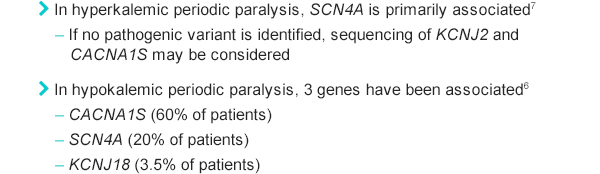
Genetic testing can help confirm a suspected
diagnosis. However, there may be other gene variants
involved in PPP, and the absence of a known genetic
alteration does not preclude diagnosis5
Order a no-cost genetic test here
|
|
|
|
|
Contact your Area Business Specialist
[First, Last - ABS@strongbridgebio.com]
to schedule a peer-to-peer discussion
with an expert.
|
|
|
|
References:
1. Charles G, Zheng C, Lehmann-Horn F, Jurkat-Rott K, Levitt J. Characterization of hyperkalemic periodic paralysis: a survey of genetically diagnosed individuals. J Neurol. 2013;260:2606-2613.
2. Arya SN. Periodic paralysis. J Indian Acad Clin Med. 2002;3:374-382.
3. Cavel-Greant D, Lehmann-Horn F, Jurkat-Rott K. The impact of permanent muscle weakness on quality of life in periodic paralysis: a survey of 66 patients. Acta Myol. 2012;31:126-133.
4. Fontaine B, Phillips LH 2nd. A newly approved drug for a rare group of diseases: dichlorphenamide for periodic paralysis. Neurology. 2016;86:1366-1367.
5. Statland JM, Fontaine B, Hanna MG, et al. Review of the diagnosis and treatment of periodic paralysis. Muscle Nerve. 2018;57:522-530.
6. Vicart S, Sternberg D, Arzel-Hézode M, et al. Hypokalemic Periodic Paralysis. NCBI Bookshelf. A service of the National Library of Medicine, National Institutes of Health. 2014.
7. Weber F, Jurkat-Rott K, Lehmann-Horn F. Hyperkalemic Periodic Paralysis. NCBI Bookshelf. A service of the National Library of Medicine, National Institutes of Health. 2016.
8. National Institutes of Health. Paramyotonia congenita. Available at: https://ghr.nlm.nih.gov/condition/paramyotonia-congenita. Accessed April 22, 2018.
9. Rose M, Griggs RC. Hereditary nondegenerative neuromuscular disease. In: Goetz CG, ed. Textbook of Clinical Neurology. 3rd Edition. New York, NY: Elsevier; 2007:814-826.
10. Ralph J, Ptaček L. Muscle channelopathies: periodic paralyses and nondystrophic myotonias. In: Rosenberg RN, Pascual JM, eds. Rosenberg’s Molecular and Genetic Basis of Neurological and Psychiatric Disease. 5th Edition. New York, NY: Elsevier; 2015:1177-1189.
|
|
This message was sent by: Strongbridge Biopharma • 900 Northbrook Drive, Suite 200 • Trevose, PA 19053
|
|
This message and any attachments are for the designated recipient only and may contain privileged, proprietary, or otherwise private information. If you have received this in error, please notify the sender immediately and delete this message. Any other use of this email is prohibited.
|
|
Unsubscribe from this list.
|

|
|
www.strongbridgebio.com
|
|
© 2018 Strongbridge Biopharma plc
|
|
STRONGBRIDGE BIOPHARMA® is a registered trademark of the Strongbridge Biopharma plc. companies, which include Strongbridge Ireland Limited and Strongbridge U.S. Inc.
|
|
KEV-0425 10/2018
|
 Spinal cord injury
 psychiatric disorders