|
|
|
Trouble viewing this e-mail? Please click here to view in your browser.
|
|
Prescribing Information
|
Important Safety Information
|
|
Indication
|
|
KEVEYIS is indicated for the treatment of primary hyperkalemic periodic paralysis, primary hypokalemic periodic paralysis, and related variants.
|
|
Please see Important Safety Information below.
|
|
|
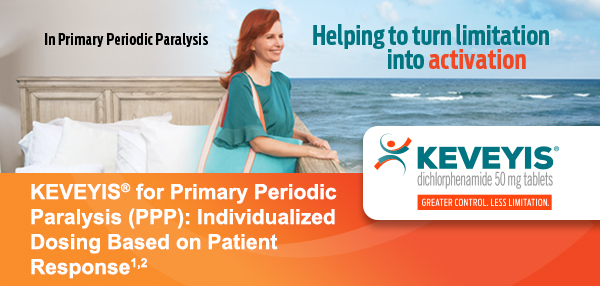
An Individualized Approach to Dosing KEVEYIS
May Be Needed1
|
|
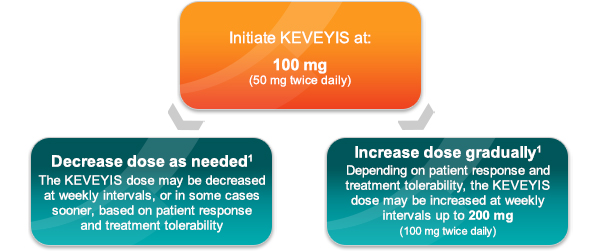
The appropriate dose of KEVEYIS (available as 50-mg tablets) is determined based on clinical response to treatment and tolerability.1
|
|
|
Because response to KEVEYIS may vary, re-evaluation
after 2 months is recommended1
|
|
KEVEYIS Has a Well-Established Tolerability Profile1,2
|
|
The most common adverse reactions (ARs) with rates greater than placebo in patients treated with KEVEYIS were paresthesia, cognitive disorder,* dysgeusia, and confusional state (KEVEYIS, n=36; placebo, n=29).1
|
| • |
In clinical studies, adverse reactions did not generally result in discontinuation2 |
| • |
Dose adjustment based on individual response may be helpful in managing adverse events1 |
|
|
*“Cognitive disorder” included cases with the preferred terms of cognitive disorder, disturbance in attention, and mental impairment.1
|
|
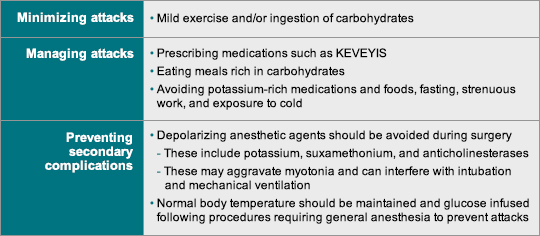
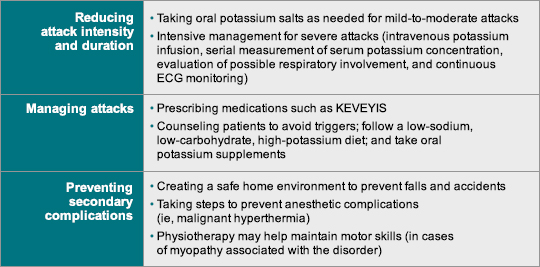
Both Medical and Lifestyle Management Approaches Can Help Manage Attacks of PPP3,4
|
|
In hyperkalemic periodic paralysis…3
|
|
|
In hypokalemic periodic paralysis…4
|
|

|
Get additional information about efficacy, safety,
and dosing guidelines for KEVEYIS.
|

|
|
|
|
|
Contact your Area Business Specialist
[First, Last - ABS@strongbridgebio.com]
to schedule a discussion about KEVEYIS.
|
|
|
|
|
Important Safety Information
|
|
Contraindications
|
| • |
Hypersensitivity to dichlorphenamide or other sulfonamides |
| • |
Concomitant use of KEVEYIS and high-dose aspirin |
| • |
Severe pulmonary disease, limiting compensation to metabolic acidosis caused by KEVEYIS |
| • |
Hepatic insufficiency: KEVEYIS may aggravate hepatic encephalopathy |
|
|
Warnings and Precautions
|
|
Hypersensitivity/Anaphylaxis/Idiosyncratic Reactions
|
| • |
Fatalities associated with the administration of sulfonamides have occurred due to adverse reactions including Stevens-Johnson syndrome, toxic epidermal necrolysis, fulminant hepatic necrosis, agranulocytosis, aplastic anemia and other blood dyscrasias. |
| • |
Pulmonary involvement can occur in isolation or as part of a systemic reaction. |
| • |
Discontinue KEVEYIS at the first appearance of skin rash or any sign of immune-mediated or idiosyncratic adverse reaction. |
|
|
Concomitant Use of Aspirin
|
| • |
Anorexia, tachypnea, lethargy, and coma have been reported with concomitant use of dichlorphenamide and high-dose aspirin. |
| • |
The concomitant use of KEVEYIS and high-dose aspirin is contraindicated. |
| • |
Use with caution in patients receiving low-dose aspirin. |
|
|
Hypokalemia
|
| • |
KEVEYIS increases potassium excretion and can cause hypokalemia. |
| • |
The risk of hypokalemia is greater when KEVEYIS is used in patients with conditions associated with hypokalemia (eg, adrenocortical insufficiency, hyperchloremic metabolic acidosis, or respiratory acidosis), and in patients receiving other drugs that may cause hypokalemia (eg, loop diuretics, thiazide diuretics, laxatives, antifungals, penicillin, and theophylline). |
| • |
Baseline and periodic measurements of serum potassium are recommended. |
| • |
If hypokalemia develops or persists, consider reducing the dose or discontinuing KEVEYIS. |
|
|
Metabolic Acidosis
|
| • |
KEVEYIS can cause hyperchloremic non–anion gap metabolic acidosis. |
| • |
Concomitant use of KEVEYIS with other drugs that cause metabolic acidosis may increase the severity of metabolic acidosis. |
| • |
Baseline and periodic measurements of serum bicarbonate are recommended. |
| • |
If metabolic acidosis develops or persists, consider reducing the dose or discontinuing KEVEYIS. |
|
|
Falls
|
| • |
KEVEYIS increases the risk of falls; risk is greater in the elderly and with higher doses. |
| • |
Consider dose reduction or discontinuation of KEVEYIS in patients who experience falls while treated with KEVEYIS. |
|
|
Pregnancy and Lactation
|
|
Use during pregnancy only if the potential benefit justifies the potential risk to the fetus. It is not known in humans whether dichlorphenamide is excreted in human milk; exercise caution when administered to a nursing woman.
|
|
Adverse Reactions
|
|
The most common adverse reactions seen in clinical trials (incidence ≥ 10% and greater than placebo) include paresthesias, cognitive disorder, dysgeusia, and confusional state.
|
|
Please see Full Prescribing Information.
|
|
|
References:
1. KEVEYIS Prescribing Information. Feasterville-Trevose, PA: Strongbridge Biopharma; 2017.
2. Sansone VA, Burge J, McDermott MP, et al; the Muscle Study Group. Randomized, placebo-controlled trials of dichlorphenamide in periodic paralysis. Neurology. 2016;86:1408-1416.
3. Weber F, Jurkat-Rott K, Lehmann-Horn F. Hyperkalemic Periodic Paralysis. NCBI Bookshelf. A service of the National Library of Medicine, National Institutes of Health. 2016.
4. Vicart S, Sternberg D, Arzel-Hézode M, et al. Hypokalemic Periodic Paralysis. NCBI Bookshelf. A service of the National Library of Medicine, National Institutes of Health. 2014.
|
|
This message was sent by: Strongbridge Biopharma • 900 Northbrook Drive, Suite 200 • Trevose, PA 19053
|
This message and any attachments are for the designated recipient only and may contain privileged,
proprietary, or otherwise private information. If you have received this in error, please notify the sender
immediately and delete this message. Any other use of this email is prohibited.
|
|
Unsubscribe from this list.
|

|
|
www.strongbridgebio.com
|
|
© 2018 Strongbridge Biopharma plc
|
KEVEYIS® is a registered trademark licensed exclusively in the U.S. to Strongbridge Biopharma plc.
STRONGBRIDGE BIOPHARMA® is a registered trademark of the Strongbridge Biopharma plc. companies,
which include Strongbridge Ireland Limited and Strongbridge U.S. Inc.
|
|
KEV-0428 10/2018
|
|
|