|
\Hello \ \Dr. \ \##accFname##,,
|
[Variable opening message]
- As you evaluate treatment options for your patients with chronic ITP, I’d like to highlight the targeted mechanism of action of TAVALISSE.
- I appreciated the opportunity to speak with you earlier. As a follow-up to our conversation, I wanted to provide some essential information about the mechanism of action of TAVALISSE.
- As your representative for TAVALISSE with Rigel Pharmaceuticals, I wanted to provide you with insights into the mechanism of action of TAVALISSE and how it differs from other approved therapies for chronic ITP.
- With the multiple treatment options available for chronic ITP, I wanted to share the MOA of TAVALISSE, which may be useful as you consider treatment plans for your patients.
- I hope you’re doing well. Are you familiar with the mechanism of action for TAVALISSE? Below, I’ve shared some key information on the novel MOA of this SYK inhibitor.
|
|
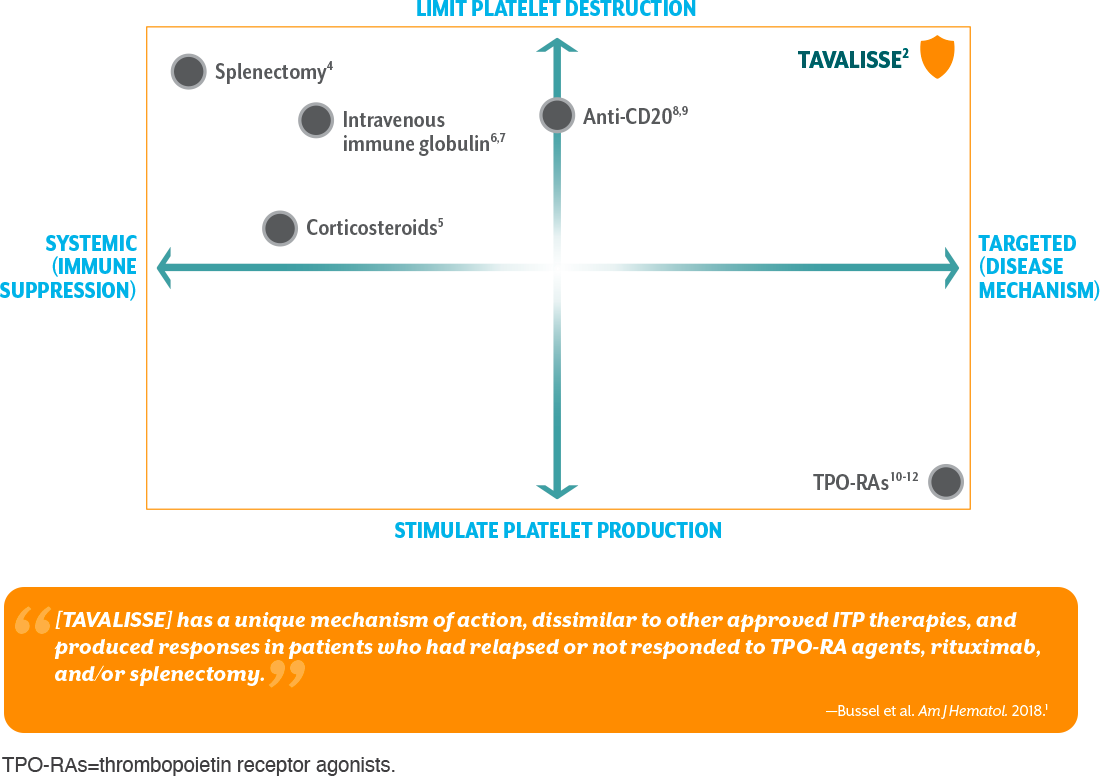
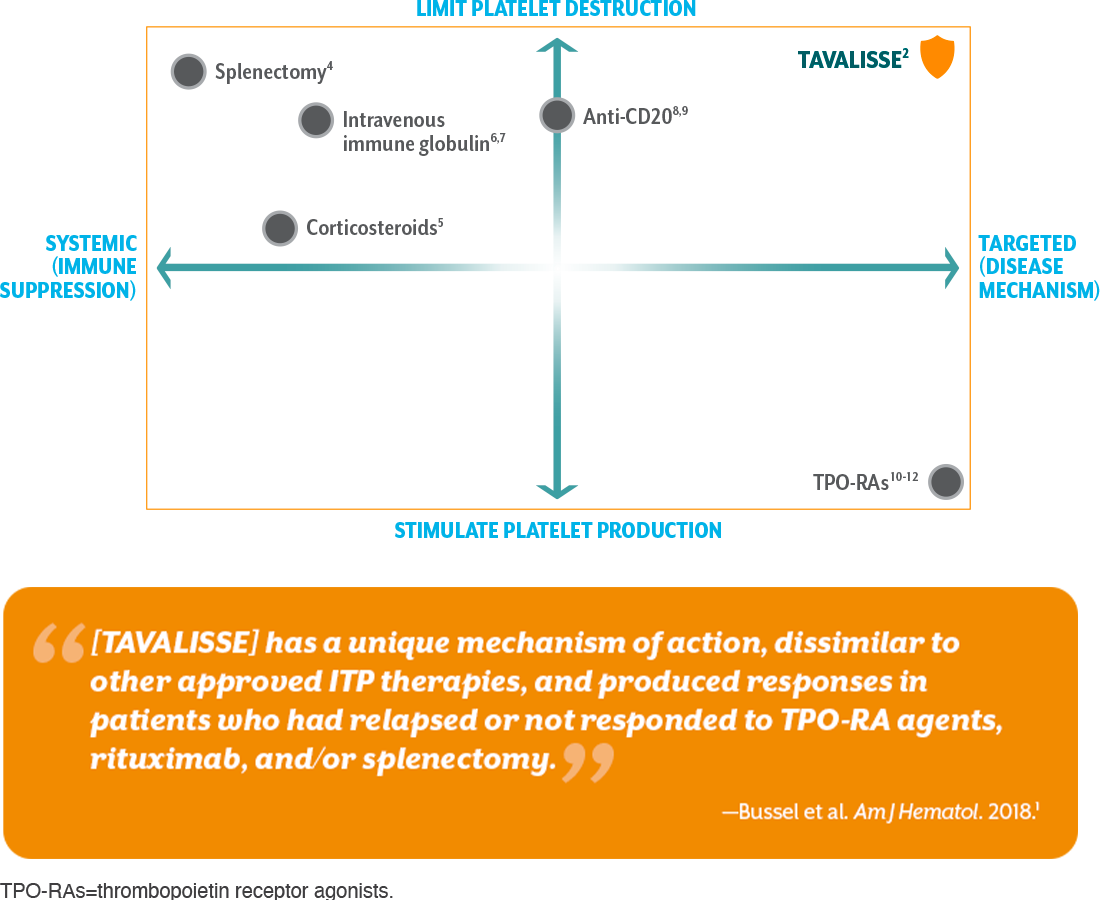
Limiting platelet destruction with the targeted mechanism of TAVALISSE is a novel way to treat chronic immune thrombocytopenia (ITP).1,2
|
|
Indication
|
| TAVALISSE is indicated for the treatment of thrombocytopenia in adult patients with chronic immune thrombocytopenia (ITP) who have had an insufficient response to a previous treatment.
|
|
Select Important Safety Information
|
| Hypertension can occur with TAVALISSE treatment. Patients with pre-existing hypertension may be more susceptible to the hypertensive effects. Monitor blood pressure every 2 weeks until stable, then monthly, and adjust or initiate antihypertensive therapy for blood pressure control maintenance during therapy. If increased blood pressure persists, TAVALISSE interruption, reduction, or discontinuation may be required.
|
Please see additional Important Safety Information below.
| TAVALISSE is a novel agent that addresses an unmet need. As the first and only FDA-approved agent that targets spleen tyrosine kinase (SYK) in macrophages to inhibit downstream signaling in chronic ITP, it presents an opportunity to redefine the treatment landscape.1,3 |
|
|
[Variable fragment: CTA]
Download the Enrollment Form
Enroll patients in RIGEL ONECARE® for patient support services, including benefits verification, prior authorizations, temporary and long-term free drug supply, and adherence support. All Rigel programs are subject to eligibility requirements. Restrictions may apply.
|
Download the Dosing and Administration Guide
Learn about the convenience of oral dosing without food restrictions, dosing modifications, and management of certain adverse reactions.
|
Download the Patient Brochure
This brochure provides information on chronic ITP, how TAVALISSE is different from other therapies, and how TAVALISSE can help patients reach their treatment goals.
|
|
|
[Variable closing message]
- I’d be happy to discuss the MOA of TAVALISSE or to share additional information from the clinical trials at your convenience. I look forward to hearing from you soon.
- Thank you for taking the time to explore the MOA of TAVALISSE. I look forward to our next discussion and would like to schedule time to meet at your earliest convenience.
- I appreciate you taking the time to review this information. Let me know if there is more you would like to know about TAVALISSE for the treatment of chronic ITP.
- I appreciate your time and interest in the novel way TAVALISSE treats chronic ITP. As your representative with Rigel Pharmaceuticals, I’m here to answer any questions you might have.
- As your TAVALISSE representative with Rigel Pharmaceuticals, I’m here to support you—please reach out with any questions regarding TAVALISSE, or to schedule a follow-up meeting.
|
|
[Variable sign-off: false Sincerely true Kind regards true Best true Talk soon true Thank you true Thanks again],
|
[Optional
representative photo]
|
[Prepopulated representative name]
[Prepopulated representative phone number]
[Prepopulated representative email]
|
Indication
TAVALISSE is indicated for the treatment of thrombocytopenia in adult patients with chronic immune
thrombocytopenia (ITP) who have had an insufficient response to a previous treatment.
Important Safety Information
Warnings and Precautions
| • |
Hypertension can occur with TAVALISSE treatment. Patients with pre-existing hypertension may be more
susceptible to the hypertensive effects. Monitor blood pressure every 2 weeks until stable, then monthly,
and adjust or initiate antihypertensive therapy for blood pressure control maintenance during therapy. If
increased blood pressure persists, TAVALISSE interruption, reduction, or discontinuation may be required.
|
| • |
Elevated liver function tests (LFTs), mainly ALT and AST, can occur with TAVALISSE. Monitor LFTs monthly
during treatment. If ALT or AST increase to ≥3 x upper limit of normal, manage hepatotoxicity using
TAVALISSE interruption, reduction, or discontinuation.
|
| • |
Diarrhea occurred in 31% of patients and severe diarrhea occurred in 1% of patients treated with
TAVALISSE. Monitor patients for the development of diarrhea and manage using supportive care measures
early after the onset of symptoms. If diarrhea becomes severe (≥Grade 3), interrupt, reduce dose or
discontinue TAVALISSE.
|
| • |
Neutropenia occurred in 6% of patients treated with TAVALISSE; febrile neutropenia occurred in 1% of
patients. Monitor the ANC monthly and for infection during treatment. Manage toxicity with TAVALISSE
interruption, reduction, or discontinuation.
|
| • |
TAVALISSE can cause fetal harm when administered to pregnant women. Advise pregnant women the potential
risk to a fetus. Advise females of reproductive potential to use effective contraception during treatment
and for at least 1 month after the last dose. Verify pregnancy status prior to initiating TAVALISSE.
It is unknown if TAVALISSE or its metabolite is present in human milk. Because of the potential for
serious adverse reactions in a breastfed child, advise a lactating woman not to breastfeed during
TAVALISSE treatment and for at least 1 month after the last dose.
|
Drug Interactions
| • |
Concomitant use of TAVALISSE with strong CYP3A4 inhibitors increases exposure to the major active
metabolite of TAVALISSE (R406), which may increase the risk of adverse reactions. Monitor for toxicities
that may require a reduction in TAVALISSE dose.
|
| • |
It is not recommended to use TAVALISSE with strong CYP3A4 inducers, as concomitant use reduces exposure to
R406.
|
| • |
Concomitant use of TAVALISSE may increase concentrations of some CYP3A4 substrate drugs and may require a
dose reduction of the CYP3A4 substrate drug.
|
| • |
Concomitant use of TAVALISSE may increase concentrations of BCRP substrate drugs (eg, rosuvastatin) and
P-Glycoprotein (P-gp) substrate drugs (eg, digoxin), which may require a dose reduction of the BCRP and
P-gp substrate drug.
|
Adverse Reactions
| • |
Serious adverse drug reactions in the ITP double-blind studies were febrile neutropenia, diarrhea,
pneumonia, and hypertensive crisis, which occurred in 1% of TAVALISSE patients. In addition, severe
adverse reactions occurred including dyspnea and hypertension (both 2%), neutropenia, arthralgia, chest
pain, diarrhea, dizziness, nephrolithiasis, pain in extremity, toothache, syncope, and hypoxia (all 1%).
|
| • |
Common adverse reactions (≥5% and more common than placebo) from FIT-1 and FIT-2 included: diarrhea,
hypertension, nausea, dizziness, ALT and AST increased, respiratory infection, rash, abdominal pain,
fatigue, chest pain, and neutropenia.
|
|
|
|
|
Please see
TAVALISSEhcp.com
for
full Prescribing Information.
To report side effects of prescription drugs to the FDA, visit
www.fda.gov/medwatch
or call
1-800-FDA-1088
(1-800-332-1088).
|
References: 1. Bussel J, Arnold DM, Grossbard E, et al. Fostamatinib
for the treatment of adult persistent and chronic immune thrombocytopenia:
results of two phase 3, randomized, placebo-controlled trials. Am J Hematol.
2018;93(7):921-930. 2. TAVALISSE®. Package insert.
Rigel Pharmaceuticals, Inc. 3. Newland A, Lee E, McDonald V, et al.
Fostamatinib for persistent/chronic adult immune thrombocytopenia.
Immunotherapy. 2018;10(1):9-25. 4. Ghanima W, Godeau B, Cines DB, et al.
How I treat immune thrombocytopenia: the choice between splenectomy or a
medical therapy as a second-line treatment. Blood. 2012;120(5):960-969. 5. Mizutani H, Furubayashi T, Imai Y. Mechanisms of corticosteroid action in
immune thrombocytopenic purpura (ITP): experimental studies using ITP-prone
mice, (NZW x BXSB) F1. Blood. 1992;79(4):942-947. 6. Kistanguri G, McCrae KR.
Immune thrombocytopenia. Hematol Oncol Clin North Am. 2013;27(3):495-520. 7.
WinRho® SDF Package insert. Saol Therapeutics, Inc. 8. Stasi R, Pagano A, Stipa E, Amadori S. Rituximab chimeric
anti-CD20 monoclonal antibody treatment for adults with chronic idiopathic
thrombocytopenic purpura. Blood. 2001;98(4):952-957.
9. Rituxan® Package insert. Genentech, Inc. 10. Doptelet® Package insert. AkaRx. 11. Nplate® Package insert. Amgen, Inc. 12. Promacta® Package insert. Novartis Pharmaceuticals Corporation.
|
|
|
|
|
|