|
|
\Hello
\Dr
\##accLname##,
\I hope all is well with you. I have
data for REZLIDHIA in patients who were previously treated with
a venetoclax-based regimen that I think you’ll find
interesting.
INDICATION
REZLIDHIA is indicated for the treatment of adult
patients with relapsed or refractory acute myeloid leukemia
(AML) with a susceptible isocitrate dehydrogenase-1 (IDH1)
mutation as detected by an FDA-approved test.
SELECT IMPORTANT
SAFETY INFORMATION
|
WARNING:
DIFFERENTIATION SYNDROME
Differentiation
syndrome, which can be fatal, can occur with
REZLIDHIA treatment. Symptoms may include
dyspnea, pulmonary infiltrates/
pleuropericardial effusion,
kidney injury, hypotension, fever, and
weight gain. If differentiation syndrome is
suspected, withhold REZLIDHIA and initiate
treatment with corticosteroids and
hemodynamic monitoring until symptom
resolution.
|
Please see additional
Important Safety
Information
below and Full
Prescribing
Information, including Boxed
WARNING.
|
AFTER
A VENETOCLAX-
BASED
REGIMEN,
PATIENTS
WITH
AML MAY
EXPERIENCE
POOR
OUTCOMES
|
|
• |
Virtually all patients with acute myeloid
leukemia (AML) eventually relapse, become
intolerant, or become resistant to a
venetoclax-based treatment, even after a
favorable initial result1-8
|
|
• |
Outcomes for patients after venetoclax-based
regimens are often dismal1-8
|
Effective treatment after a
venetoclax-based
regimen
is an area of
urgent
unmet clinical need1-3,5-8
|
|
REZLIDHIA
PROVIDED A
CLINICALLY
MEANINGFUL
RESPONSE
WITH DURABLE,
COMPLETE REMISSION
|
|
Efficacy Results in Patients with Relapsed
or
Refractory
IDH1-mutated
AML (N=147)9,10,*
|
|
Endpoint
|
Results with REZLIDHIA
|
|
Patients achieving CR/CRh†
|
35% (95%
CI, 27.0, 43.0)
|
|
Patients achieving CRc
|
45%
|
|
Median duration of CR/CRh
|
25.9 months (95%
CI, 13.5, NR)
|
|
Median time to CR or CRh
|
1.9 months (range:
0.9-5.6)
|
|
PATIENTS
TREATED WITH
VENETOCLAX
IN
THE
PIVOTAL
TRIAL HAD
RESPONSES
THAT WERE
CONSISTENT
WITH THE
OVERALL POPULATION
|
|
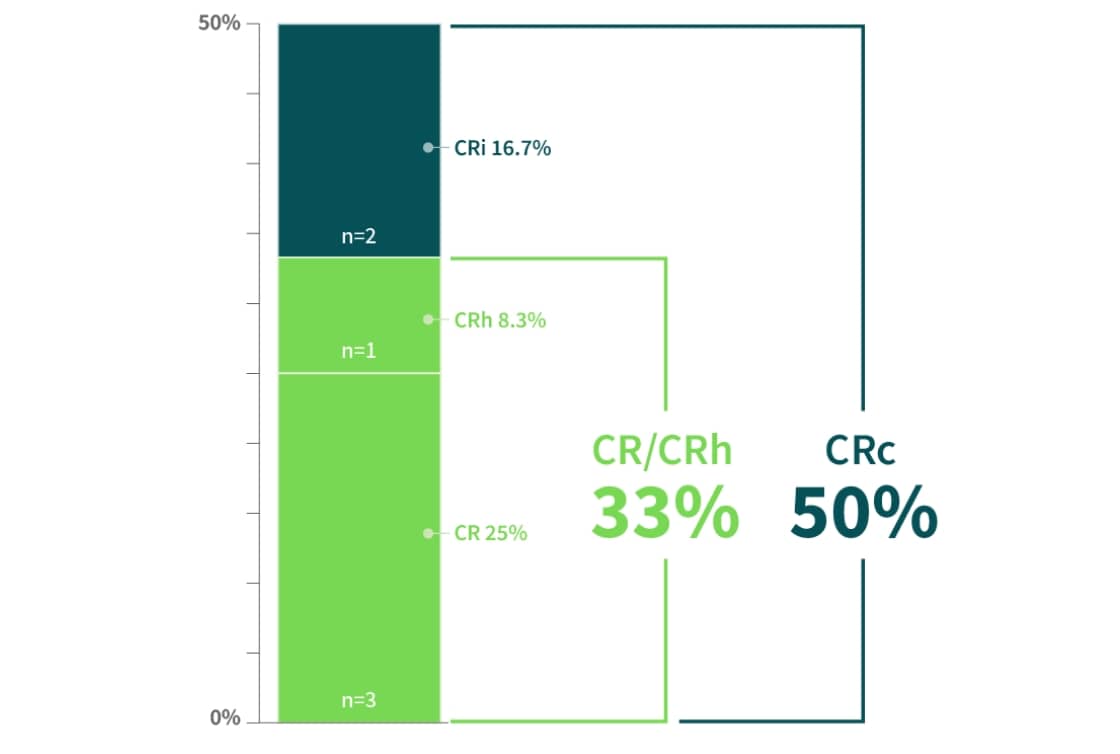
Findings from a subgroup analysis of 12 patients treated with a
venetoclax-based regimen prior to treatment with REZLIDHIA8,10
Clinical Response
Rates (n=12)8,10,11
|
• |
Median time to CR/CRh was 2.35 months (range:
1-2.8 months)8,11
|
|
• |
Median duration of previous venetoclax-based
treatment was 7 months (range: 2-34 months)11
|
“Results in patients who
received prior venetoclax were also promising; the
remission rate was consistent with that of the broader
study population, and most patients who achieved
remission had an ongoing remission at the time of
data cutoff.”
—de
Botton et al. Blood Adv. 2023.10
Discover More at REZLIDHIAhcp.com
\Thank you for your time. I look
forward to our next appointment.
\Sincerely,
|
|
IMPORTANT SAFETY
INFORMATION (CONT’D)
WARNINGS AND
PRECAUTIONS
Differentiation Syndrome
REZLIDHIA can cause differentiation syndrome. In
the clinical trial of REZLIDHIA in patients with relapsed or
refractory AML, differentiation syndrome occurred in 16% of
patients, with grade 3 or 4 differentiation syndrome occurring
in 8% of patients treated, and fatalities in 1% of patients.
Differentiation syndrome is associated with rapid proliferation
and differentiation of myeloid cells and may be life-threatening
or fatal. Symptoms of differentiation syndrome in patients
treated with REZLIDHIA included leukocytosis, dyspnea, pulmonary
infiltrates/pleuropericardial effusion, kidney injury, fever,
edema, pyrexia, and weight gain. Of the 25 patients who
experienced differentiation syndrome, 19 (76%) recovered after
treatment or after dose interruption of REZLIDHIA.
Differentiation syndrome occurred as early as 1 day and up to 18
months after REZLIDHIA initiation and has been observed with or
without concomitant leukocytosis.
If differentiation syndrome is suspected,
temporarily withhold REZLIDHIA and initiate systemic
corticosteroids (e.g., dexamethasone 10 mg IV every 12 hours)
for a minimum of 3 days and until resolution of signs and
symptoms. If concomitant leukocytosis is observed, initiate
treatment with hydroxyurea, as clinically indicated. Taper
corticosteroids and hydroxyurea after resolution of symptoms.
Differentiation syndrome may recur with premature
discontinuation of corticosteroids and/or hydroxyurea treatment.
Institute supportive measures and hemodynamic monitoring until
improvement; withhold dose of REZLIDHIA and consider dose
reduction based on recurrence.
Hepatotoxicity
REZLIDHIA can cause hepatotoxicity, presenting as
increased alanine aminotransferase (ALT), increased aspartate
aminotransferase (AST), increased blood alkaline phosphatase,
and/or elevated bilirubin. Of 153 patients with relapsed or
refractory AML who received REZLIDHIA, hepatotoxicity occurred
in 23% of patients; 13% experienced grade 3 or 4 hepatotoxicity.
One patient treated with REZLIDHIA in combination with
azacitidine in the clinical trial, a combination for which
REZLIDHIA is not indicated, died from complications of
drug-induced liver injury. The median time to onset of
hepatotoxicity in patients with relapsed or refractory AML
treated with REZLIDHIA was 1.2 months (range: 1 day to 17.5
months) after REZLIDHIA initiation, and the median time to
resolution was 12 days (range: 1 day to 17 months). The most
common hepatotoxicities were elevations of ALT, AST, blood
alkaline phosphatase, and blood bilirubin.
Monitor patients frequently for clinical symptoms
of hepatic dysfunction such as fatigue, anorexia, right upper
abdominal discomfort, dark urine, or jaundice. Obtain baseline
liver function tests prior to initiation of REZLIDHIA, at least
once weekly for the first two months, once every other week for
the third month, once in the fourth month, and once every other
month for the duration of therapy. If hepatic dysfunction
occurs, withhold, reduce, or permanently discontinue REZLIDHIA
based on recurrence/severity.
ADVERSE
REACTIONS
The most common (≥20%) adverse reactions,
including laboratory abnormalities, were aspartate
aminotransferase increased, alanine aminotransferase increased,
potassium decreased, sodium decreased, alkaline phosphatase
increased, nausea, creatinine increased, fatigue/malaise,
arthralgia, constipation, lymphocytes increased, bilirubin
increased, leukocytosis, uric acid increased, dyspnea, pyrexia,
rash, lipase increased, mucositis, diarrhea and transaminitis.
DRUG
INTERACTIONS
|
• |
Avoid concomitant use of REZLIDHIA with strong
or moderate CYP3A inducers. |
|
• |
Avoid concomitant use of REZLIDHIA with
sensitive CYP3A substrates unless otherwise
instructed in the substrates prescribing
information. If concomitant use is unavoidable,
monitor patients for loss of therapeutic effect
of these drugs. |
LACTATION
Advise women not to breastfeed during treatment
with REZLIDHIA and for 2 weeks after the last dose.
GERIATRIC USE
No overall differences in effectiveness were
observed between patients 65 years and older and younger
patients. Compared to patients younger than 65 years of age, an
increase in incidence of hepatotoxicity and hypertension was
observed in patients ≥65 years of age.
HEPATIC
IMPAIRMENT
In patients with mild or moderate hepatic
impairment, closely monitor for increased probability of
differentiation syndrome.
Please
see REZLIDHIAhcp.com
for Full
Prescribing Information, including Boxed
WARNING.
|
|
REFERENCES:
1. Bewersdorf JP,
Shallis RM, Derkach A, et al. Efficacy of FLT3 and IDH1/2
inhibitors in patients with acute myeloid leukemia previously
treated with venetoclax. Leuk Res. 2022;122:106942.
doi:10.1016/j.leukres.2022.106942 2. Abaza Y, Winer ES, Murthy
GSG, et al. Clinical outcomes of hypomethylating agents plus
venetoclax as frontline treatment in patients 75 years and older
with acute myeloid leukemia: real-world data from eight US
academic centers. Am J Hematol. Published online February
11, 2024. doi:10.1002/ajh.27231 3. Thol F, Döhner H, Ganser A.
How I treat refractory and relapsed acute myeloid leukemia.
Blood. 2024;143(1):11-20. doi:10.1182/blood.2023022481 4. Gangat N, Ilyas R, Johnson
IM, et al. Outcome of patients with acute myeloid leukemia
following failure of frontline venetoclax plus hypomethylating
agent therapy. Haematologica. 2023;108(11):3170-3174.
doi:10.3324/haematol.2022.282677 5. Khanna V, Azenkot T, Liu SQ,
et al. Outcomes with molecularly targeted agents as salvage
therapy following frontline venetoclax + hypomethylating agent
in adults with acute myeloid leukemia: a multicenter
retrospective analysis. Leuk Res. 2023;131:107331.
doi:10.1016/j.leukres.2023.107331 6. Maiti A, Qiao W, Sasaki K, et
al. Venetoclax with decitabine vs intensive chemotherapy in
acute myeloid leukemia: a propensity score matched analysis
stratified by risk of treatment-related mortality. Am J
Hematol. 2021;96(3):282-291. doi:10.1002/ajh.26061 7. Tenold ME, Moskoff BN,
Benjamin DJ, et al. Outcomes of adults with relapsed/refractory
acute myeloid leukemia treated with venetoclax plus
hypomethylating agents at a comprehensive cancer center.
Front Oncol. 2021;11:649209. doi:10.3389/fonc.2021.649209
8. Cortes J, Jonas BA, Schiller
G, et al. Olutasidenib in post-venetoclax patients with mutant
isocitrate dehydrogenase 1 (mIDH1) acute myeloid leukemia
(AML). Leuk Lymphoma. Published online March 27, 2024.
doi:10.1080/10428194.2024.2333451 9. REZLIDHIA®
[package insert], South San Francisco, CA: Rigel
Pharmaceuticals, Inc. 10. de
Botton S, Fenaux P, Yee K, et al. Olutasidenib (FT-2102) induces
durable complete remissions in patients with relapsed or
refractory IDH1-mutated AML. Blood Adv.
2023;7(13):3117-3127. doi:10.1182/bloodadvances.2022009411
11. Data on file, Rigel
Pharmaceuticals, Inc. January 2024.
|
|
|