|
\Hello \ \Dr. \ \##accFname##,
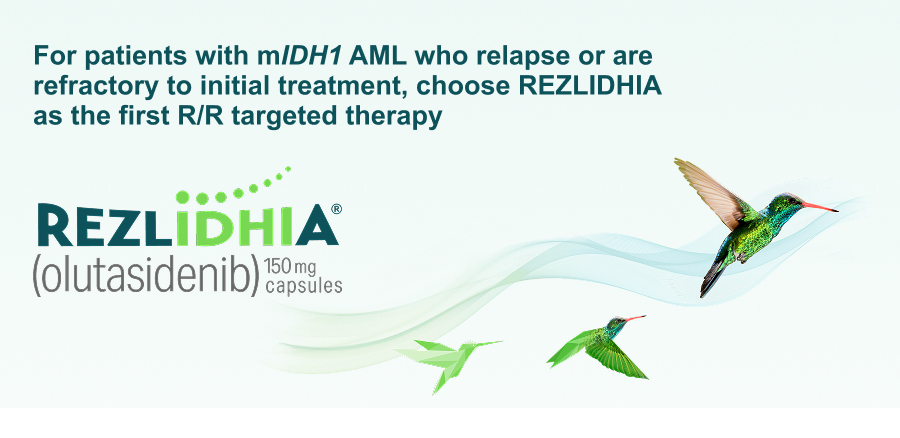
\As we recognize AML Awareness Month, I wanted to share some key highlights about a treatment option for your patients with relapsed or refractory mIDH1 AML.
|
|
Over half (57%) of patients with AML treated with induction therapy die or have relapsed/refractory AML within 12 months of diagnosis. Advances in targeted therapies offer the potential for more personalized treatment approaches and improved outcomes.1‑3
|
|
IDH1 gene mutations have been reported in 6% to 9% of patients with AML
|
|
In such a vulnerable patient population, it's important to test for IDH1, an identified, actionable mutation with options for targeted treatment.4-6
|
|
|
|
|
|
INDICATION
REZLIDHIA is indicated for the treatment of adult patients with relapsed or
refractory acute myeloid leukemia (AML) with a susceptible isocitrate
dehydrogenase-1 (IDH1) mutation as detected by an FDA-approved test.
|
IMPORTANT SAFETY INFORMATION
WARNING: DIFFERENTIATION SYNDROME
Differentiation syndrome, which can be fatal, can
occur with REZLIDHIA treatment. Symptoms may include dyspnea, pulmonary
infiltrates/
pleuropericardial effusion, kidney injury, hypotension, fever, and weight gain. If differentiation syndrome is suspected, withhold REZLIDHIA and initiate treatment with corticosteroids and hemodynamic monitoring until symptom resolution.
|
Please see additional Important Safety Information below
and Full
Prescribing Information, including Boxed WARNING.
|
|
| |
REZLIDHIA CLINICAL SUMMARY*
|
|
| |
|
Almost half of patients achieved a composite complete remission7-9
|
|
35% CR/CRh
|
|
32% CR
|
|
45% CRc
|
|
|
Over 2-year duration of response9
|
|
25.3 months median duration of CR/CRh
|
|
|
|
|
High-risk subgroups saw results consistent with overall population8-13
|
Post venetoclax (n=12): 50% CRc
Post-intensive chemotherapy† (n=13):
46% CRc
|
|
|
Median time to response was less than 2 months9
|
|
88% of responders achieved CR/CRh within 4 months
|
|
|
|
|
Well-characterized safety profile7,9
|
|
Long-term use revealed no new safety signals
|
|
|
|
|
|
*Data from an open-label, single-arm, multicenter clinical trial in 153 adult patients (147 efficacy evaluable) with relapsed or refractory AML with an IDH1 mutation. All response data is tied to a June 15, 2023 data cutoff. The safety profile uses a June 18, 2021 data cutoff.
†Intensive chemotherapy was the only prior regimen these patients received. Intensive chemotherapy was defined as high-dose cytarabine with daunorubicin, mitoxantrone with etoposide and cytarabine, or transplant conditioning regimens, whether myeloablative or not.
CR=complete remission; CRc=composite complete remission (CR+CRh+CRi); CRh=CR with partial hematologic recovery; CRi=complete remission with incomplete blood count recovery; R/R=relapsed or refractory.
|
|
|
|
|
LOOKING FOR MORE? FIND SUPPORT RESOURCES BELOW.
|
 Find support every step of treatment,
including how to
access REZLIDHIA, copay assistance, patient support services,
and downloadable resources for you and your patients.
|
|
|
\I’d be happy to discuss more about treatment with REZLIDHIA for your patients with R/R mIDH1 AML. Please reach out with any questions you may have.
\Sincerely,
|
|
| IMPORTANT SAFETY INFORMATION (CONT'D) |
WARNINGS AND PRECAUTIONS
Differentiation Syndrome
REZLIDHIA can cause differentiation syndrome. In the clinical trial of
REZLIDHIA in patients with relapsed or refractory AML, differentiation
syndrome occurred in 16% of patients, with grade 3 or 4 differentiation
syndrome occurring in 8% of patients treated, and fatalities in 1% of
patients. Differentiation syndrome is associated with rapid proliferation
and differentiation of myeloid cells and may be life-threatening or fatal.
Symptoms of differentiation syndrome in patients treated with REZLIDHIA
included leukocytosis, dyspnea, pulmonary infiltrates/pleuropericardial
effusion, kidney injury, fever, edema, pyrexia, and weight gain. Of the 25
patients who experienced differentiation syndrome, 19 (76%) recovered after
treatment or after dose interruption of REZLIDHIA. Differentiation syndrome
occurred as early as 1 day and up to 18 months after REZLIDHIA initiation
and has been observed with or without concomitant leukocytosis.
If differentiation syndrome is suspected, temporarily withhold REZLIDHIA and
initiate systemic corticosteroids (e.g., dexamethasone 10 mg IV every 12
hours) for a minimum of 3 days and until resolution of signs and symptoms.
If concomitant leukocytosis is observed, initiate treatment with
hydroxyurea, as clinically indicated. Taper corticosteroids and hydroxyurea
after resolution of symptoms. Differentiation syndrome may recur with
premature discontinuation of corticosteroids and/or hydroxyurea treatment.
Institute supportive measures and hemodynamic monitoring until improvement;
withhold dose of REZLIDHIA and consider dose reduction based on recurrence.
Hepatotoxicity
REZLIDHIA can cause hepatotoxicity, presenting as increased alanine
aminotransferase (ALT), increased aspartate aminotransferase (AST),
increased blood alkaline phosphatase, and/or elevated bilirubin. Of 153
patients with relapsed or refractory AML who received REZLIDHIA,
hepatotoxicity occurred in 23% of patients; 13% experienced grade 3 or 4
hepatotoxicity. One patient treated with REZLIDHIA in combination with
azacitidine in the clinical trial, a combination for which REZLIDHIA is not
indicated, died from complications of drug-induced liver injury. The median
time to onset of hepatotoxicity in patients with relapsed or refractory AML
treated with REZLIDHIA was 1.2 months (range: 1 day to 17.5 months) after
REZLIDHIA initiation, and the median time to resolution was 12 days (range:
1 day to 17 months). The most common hepatotoxicities were elevations of
ALT, AST, blood alkaline phosphatase, and blood bilirubin.
Monitor patients frequently for clinical symptoms of hepatic dysfunction
such as fatigue, anorexia, right upper abdominal discomfort, dark urine, or
jaundice. Obtain baseline liver function tests prior to initiation of
REZLIDHIA, at least once weekly for the first two months, once every other
week for the third month, once in the fourth month, and once every other
month for the duration of therapy. If hepatic dysfunction occurs, withhold,
reduce, or permanently discontinue REZLIDHIA based on recurrence/severity.
ADVERSE REACTIONS
The most common (≥20%) adverse reactions, including laboratory
abnormalities, were aspartate aminotransferase increased, alanine
aminotransferase increased, potassium decreased, sodium decreased, alkaline
phosphatase increased, nausea, creatinine increased, fatigue/malaise,
arthralgia, constipation, lymphocytes increased, bilirubin increased,
leukocytosis, uric acid increased, dyspnea, pyrexia, rash, lipase increased,
mucositis, diarrhea and transaminitis.
DRUG INTERACTIONS
|
• |
Avoid concomitant use of REZLIDHIA with strong or moderate CYP3A
inducers. |
|
• |
Avoid concomitant use of REZLIDHIA with sensitive CYP3A substrates
unless otherwise instructed in the substrates prescribing
information. If concomitant use is unavoidable, monitor patients for
loss of therapeutic effect of these drugs. |
LACTATION
Advise women not to breastfeed during treatment with REZLIDHIA and for 2
weeks after the last dose.
GERIATRIC USE
No overall differences in effectiveness were observed between patients 65
years and older and younger patients. Compared to patients younger than 65
years of age, an increase in incidence of hepatotoxicity and hypertension
was observed in patients ≥65 years of age.
HEPATIC
IMPAIRMENT
In patients with mild or moderate hepatic impairment, closely monitor for
increased probability of differentiation syndrome.
Please see REZLIDHIAhcp.com for Full Prescribing Information, including Boxed WARNING.
|
References: 1. DiNardo CD, Cortes JE. Mutations in AML: prognostic and therapeutic implications. Hematology Am Soc Hematol Educ Program. 2016;2016(1):348-355. doi:10.1182/asheducation-2016.1.348 2. Walter RB, Othus M, Burnett AK, et al. Resistance prediction in AML: analysis of 4,601 patients from MRC/NCRI, HOVON/SAKK, SWOG, and MD Anderson Cancer Center. Leukemia. 2015;29(2):312-320. doi:10.1038/leu.2014.242 3. Tenold ME, Moskoff BN, Benjamin DJ, et al. Outcomes of adults with relapsed/refractory acute myeloid leukemia treated with venetoclax plus hypomethylating agents at a comprehensive cancer center. Front Oncol. 2021;11:649209. doi:10.3389/fonc.2021.649209 4. Abbas S, Lugthart S, Kavelaars FG, et al. Acquired mutations in the genes encoding IDH1 and IDH2 both are recurrent aberrations in acute myeloid leukemia: prevalence and prognostic value. Blood. 2010;116(12):2122-2126. doi:10.1182/blood-2009-11-250878 5. Chotirat S, Thongnoppakhun W, Promsuwicha O, Boonthimat C, Auewarakul CU. Molecular alterations of isocitrate dehydrogenase 1 and 2 (IDH1 and IDH2) metabolic genes and additional genetic mutations in newly diagnosed acute myeloid leukemia patients. J Hematol Oncol. 2012;5:5. doi:10.1186/1756-8722-5-5 6. Referenced with permission from the NCCN Clinical Practice Guidelines in Oncology (NCCN Guidelines®) for Acute Myeloid Leukemia V.3.2026. © National Comprehensive Cancer Network, Inc. 2025. All rights reserved. Accessed February 11, 2026. To view the most recent and complete version of the guideline, go online to NCCN.org. NCCN makes no warranties of any kind whatsoever regarding their content, use or application and disclaims any responsibility for their application or use in any way. 7. REZLIDHIA®. Package insert. Rigel Pharmaceuticals, Inc; 2022. 8. de Botton S, Fenaux P, Yee K, et al. Olutasidenib (FT-2102) induces durable complete remissions in patients with relapsed or refractory IDH1-mutated AML. Blood Adv. 2023;7(13):3117-3127. doi:10.1182/bloodadvances.2022009411 9. Cortes J, Curti A, Fenaux P, et al. Olutasidenib for mutated IDH1 acute myeloid leukemia: final five-year results from the phase 2 pivotal cohort. J Hematol Oncol. 2025;18(1):102. doi:10.1186/s13045-025-01751-w 10. Data on file, Rigel Pharmaceuticals, Inc. January 2025. 11. Cortes J, Curti A, Fenaux P, et al. Olutasidenib for mutated IDH1 acute myeloid leukemia: final five-year results from the phase 2 pivotal cohort (supplemental data). J Hematol Oncol. 2025; https://link.springer.com/article/10.1186/s13045-025-01751-w#Sec20 12. Maiti A, Rausch CR, Cortes JE, et al. Outcomes of relapsed or refractory acute myeloid leukemia after frontline hypomethylating agent and venetoclax regimens. Haematologica. 2021;106(3):894-898. doi:10.3324/haematol.2020.252569 13. Niscola P, Gianfelici V, Catalano G, et al. Acute myeloid leukemia in older patients: from new biological insights to targeted therapies. Curr Oncol. 2024;31(11):6632-6658. doi:10.3390/curroncol31110490
|
|
|
|
|
|