The most common adverse reactions occurring in ≥10% of patients treated with ODOMZO 200 mg were muscle spasms, alopecia, dysgeusia, fatigue, nausea, musculoskeletal pain, diarrhea, decreased weight, decreased appetite, myalgia, abdominal pain, headache, pain, vomiting, and pruritus.1
ODOMZO should not be used during pregnancy.
Please see Boxed WARNING below.
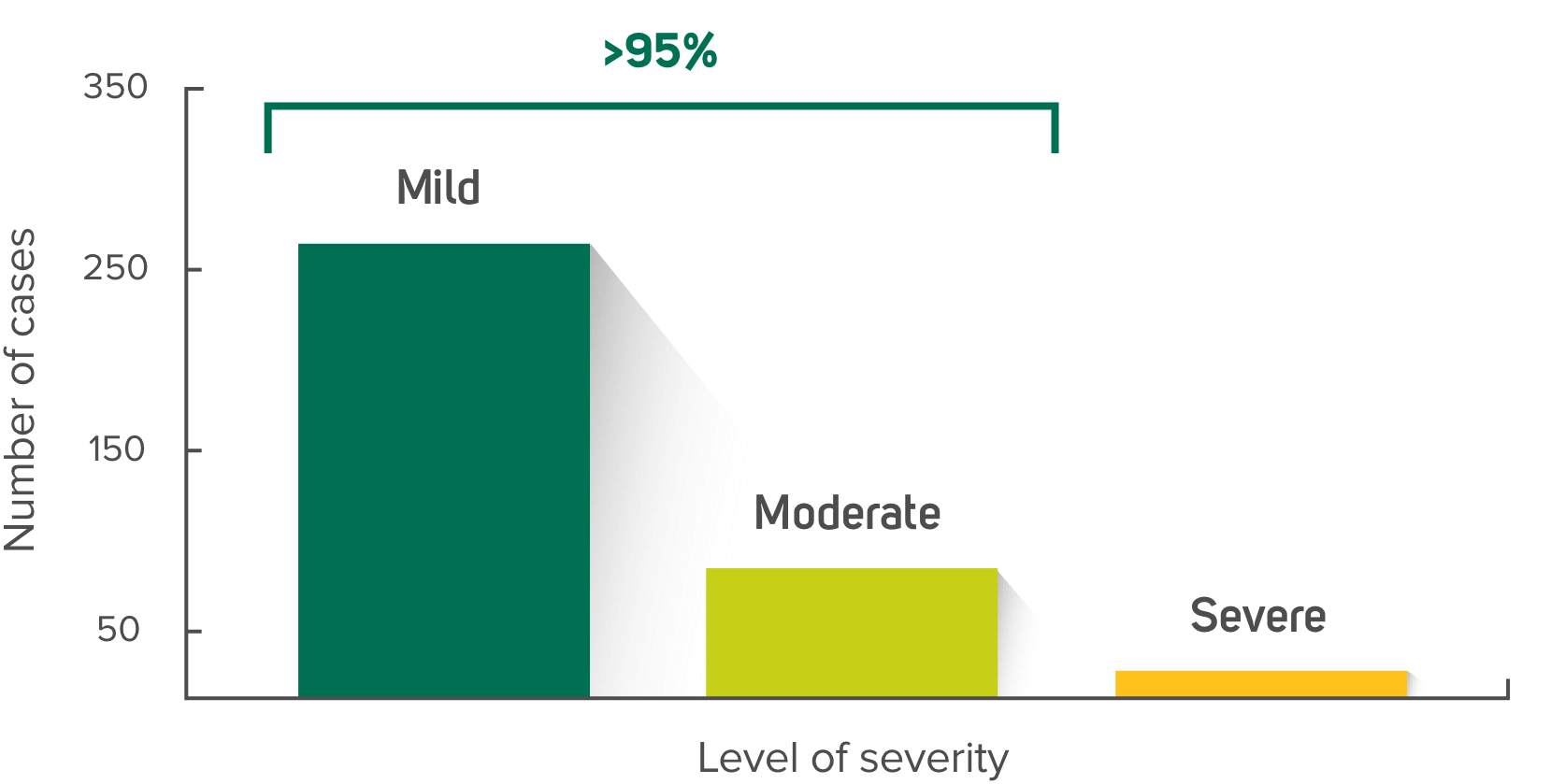
The only HHI with greater than 95% of the most common ARs being mild to moderate1-3,*
Common side effects included muscle spasms, alopecia, dysgeusia, fatigue, and nausea*
The most common adverse reactions occurring in ≥10% of patients treated with ODOMZO 200 mg were muscle spasms, alopecia, dysgeusia, fatigue, nausea, musculoskeletal pain, diarrhea, decreased weight, decreased appetite, myalgia, abdominal pain, headache, pain, vomiting, and pruritus.1
ODOMZO should not be used during pregnancy.
Please see Boxed WARNING below.
Sonidegib (ODOMZO®) is recommended by the National Comprehensive Cancer Network® (NCCN®) as NCCN Category 2A under other recommended regimens for laBCC4,†
†
NCCN makes no warranties of any kind whatsoever regarding their content, use or application and disclaims any responsibility for their application or use in any way.
Sonidegib (ODOMZO®) is recommended by the National Comprehensive Cancer Network® (NCCN®) as NCCN Category 2A under other recommended regimens for laBCC4,†
†
NCCN makes no warranties of any kind whatsoever regarding their content, use or application and disclaims any responsibility for their application or use in any way.
INDICATION
ODOMZO® (sonidegib) is indicated for the treatment of adult patients with locally advanced basal cell carcinoma (BCC) that has recurred following surgery or radiation therapy, or those who are not candidates for surgery or radiation therapy.
IMPORTANT SAFETY INFORMATION
WARNING: EMBRYO-FETAL TOXICITY
•
ODOMZO can cause embryo-fetal death or severe birth defects when administered to a pregnant woman. ODOMZO is embryotoxic, fetotoxic, and teratogenic in animals
•
Verify the pregnancy status of females of reproductive potential prior to initiating therapy. Advise females of reproductive potential to use effective contraception during treatment with ODOMZO and for at least 20 months after the last dose
•
Advise males of the potential risk of exposure through semen and to use condoms with a pregnant partner or a female partner of reproductive potential during treatment with ODOMZO and for at least 8 months after the last dose
WARNINGS AND PRECAUTIONS
Embryo-fetal Toxicity: ODOMZO can cause embryo-fetal death or severe birth defects when administered to a pregnant woman. Females of Reproductive Potential: Verify pregnancy status prior to initiating ODOMZO. Advise females to use effective contraception and not to breastfeed, due to the potential for serious adverse reactions in breastfed infants, during treatment and for at least 20 months after the last dose. Report pregnancies to Sun Pharmaceutical Industries, Inc. at 1-800-406-7984.
Males: Advise males to use condoms, even after a vasectomy, and to not donate semen during treatment and for at least 8 months after the last dose to avoid potential drug exposure in pregnant females or females of reproductive potential.
Blood Donation: Advise patients not to donate blood or blood products while taking ODOMZO, and for at least 20 months after the last dose because their blood or blood products might be given to a female of reproductive potential.
Musculoskeletal Adverse Reactions: Musculoskeletal adverse reactions, which may be accompanied by serum creatine kinase (CK) elevations, occur with ODOMZO and other drugs which inhibit the hedgehog (Hh) pathway. Obtain serum CK and creatinine levels prior to initiating therapy, periodically during treatment, and as clinically indicated. Temporary dose interruption or discontinuation of ODOMZO may be required based on the severity of musculoskeletal adverse reactions.
Premature Fusion of the Epiphyses: ODOMZO is not indicated for use in pediatric patients. Premature fusion of the epiphyses has been reported in pediatric patients exposed to ODOMZO and other Hh pathway inhibitors. In some cases, fusion progressed after discontinuation.
Drug Interactions: Avoid concomitant administration of ODOMZO with strong and moderate CYP3A inhibitors. If a moderate CYP3A inhibitor must be used, administer for less than 14 days and monitor closely for adverse reactions, particularly musculoskeletal. Avoid concomitant administration of ODOMZO with strong and moderate CYP3A inducers.
Geriatric Use: There was a higher incidence of serious adverse events, Grade 3 and 4, and events requiring dose interruption or discontinuation in patients ≥65 years compared with younger patients; this was not attributable to an increase in any specific adverse event.
Most Common Adverse Reactions: The most common adverse reactions occurring in ≥10% of patients were muscle spasms (54%), alopecia (53%), dysgeusia (46%), fatigue (41%), nausea (39%), musculoskeletal pain (32%), diarrhea (32%), decreased weight (30%), decreased appetite (23%), myalgia (19%), abdominal pain (18%), headache (15%), pain (14%), vomiting (11%), and pruritus (10%).
Click here to see the full Prescribing Information for ODOMZO, including Boxed WARNING.
ODOMZO® (sonidegib) is indicated for the treatment of adult patients with locally advanced basal cell carcinoma (BCC) that has recurred following surgery or radiation therapy, or those who are not candidates for surgery or radiation therapy.
IMPORTANT SAFETY INFORMATION
WARNING: EMBRYO-FETAL TOXICITY
•
ODOMZO can cause embryo-fetal death or severe birth defects when administered to a pregnant woman. ODOMZO is embryotoxic, fetotoxic, and teratogenic in animals
•
Verify the pregnancy status of females of reproductive potential prior to initiating therapy. Advise females of reproductive potential to use effective contraception during treatment with ODOMZO and for at least 20 months after the last dose
•
Advise males of the potential risk of exposure through semen and to use condoms with a pregnant partner or a female partner of reproductive potential during treatment with ODOMZO and for at least 8 months after the last dose
WARNINGS AND PRECAUTIONS
Embryo-fetal Toxicity: ODOMZO can cause embryo-fetal death or severe birth defects when administered to a pregnant woman. Females of Reproductive Potential: Verify pregnancy status prior to initiating ODOMZO. Advise females to use effective contraception and not to breastfeed, due to the potential for serious adverse reactions in breastfed infants, during treatment and for at least 20 months after the last dose. Report pregnancies to Sun Pharmaceutical Industries, Inc. at 1-800-406-7984.
Males: Advise males to use condoms, even after a vasectomy, and to not donate semen during treatment and for at least 8 months after the last dose to avoid potential drug exposure in pregnant females or females of reproductive potential.
Blood Donation: Advise patients not to donate blood or blood products while taking ODOMZO, and for at least 20 months after the last dose because their blood or blood products might be given to a female of reproductive potential.
Musculoskeletal Adverse Reactions: Musculoskeletal adverse reactions, which may be accompanied by serum creatine kinase (CK) elevations, occur with ODOMZO and other drugs which inhibit the hedgehog (Hh) pathway. Obtain serum CK and creatinine levels prior to initiating therapy, periodically during treatment, and as clinically indicated. Temporary dose interruption or discontinuation of ODOMZO may be required based on the severity of musculoskeletal adverse reactions.
Premature Fusion of the Epiphyses: ODOMZO is not indicated for use in pediatric patients. Premature fusion of the epiphyses has been reported in pediatric patients exposed to ODOMZO and other Hh pathway inhibitors. In some cases, fusion progressed after discontinuation.
Drug Interactions: Avoid concomitant administration of ODOMZO with strong and moderate CYP3A inhibitors. If a moderate CYP3A inhibitor must be used, administer for less than 14 days and monitor closely for adverse reactions, particularly musculoskeletal. Avoid concomitant administration of ODOMZO with strong and moderate CYP3A inducers.
Geriatric Use: There was a higher incidence of serious adverse events, Grade 3 and 4, and events requiring dose interruption or discontinuation in patients ≥65 years compared with younger patients; this was not attributable to an increase in any specific adverse event.
Most Common Adverse Reactions: The most common adverse reactions occurring in ≥10% of patients were muscle spasms (54%), alopecia (53%), dysgeusia (46%), fatigue (41%), nausea (39%), musculoskeletal pain (32%), diarrhea (32%), decreased weight (30%), decreased appetite (23%), myalgia (19%), abdominal pain (18%), headache (15%), pain (14%), vomiting (11%), and pruritus (10%).
Click here to see the full Prescribing Information for ODOMZO, including Boxed WARNING.